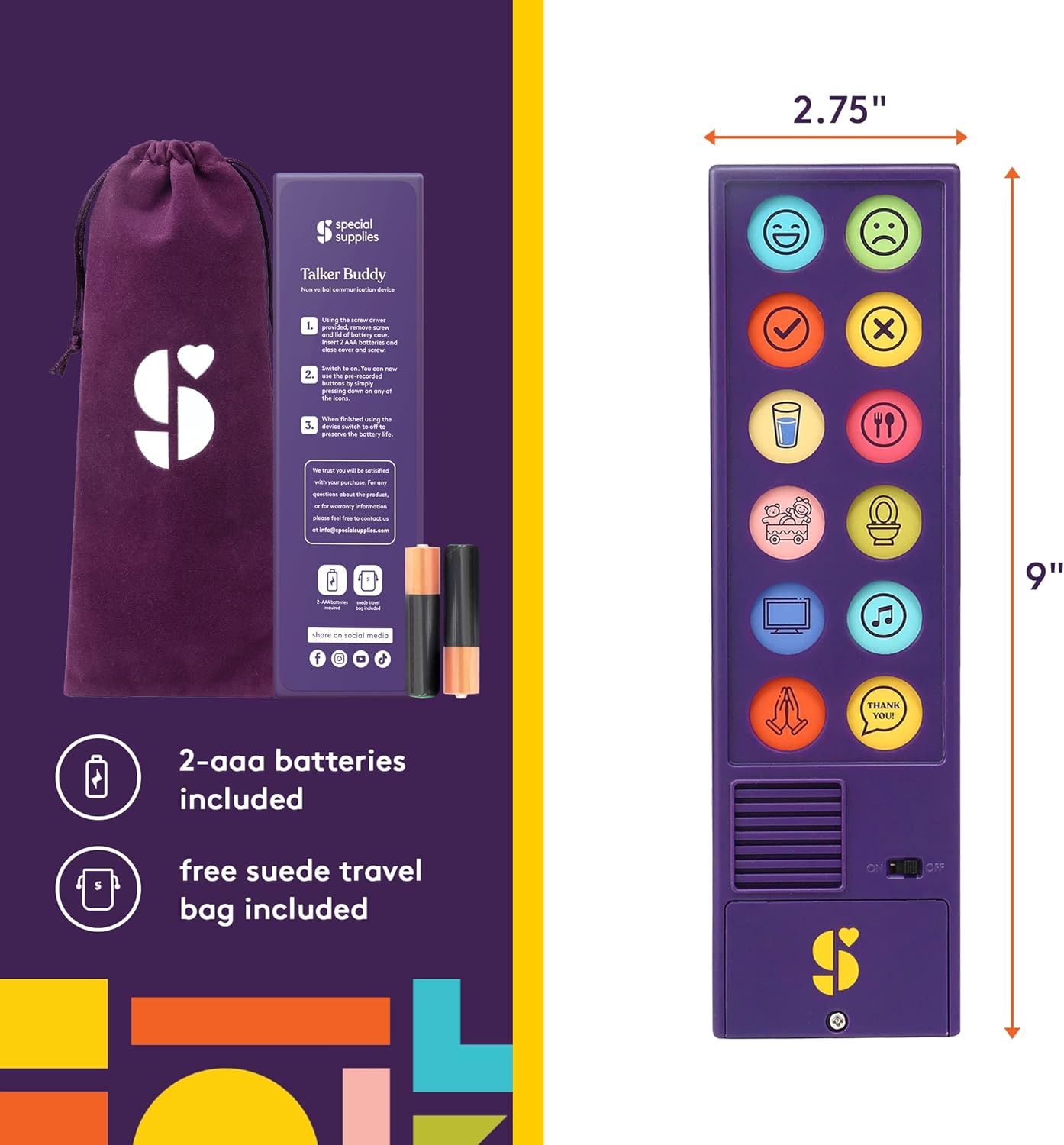
Imagine a parent sitting in a hospital family lounge, forty-eight hours after their spouse’s stroke, trying to ask the discharge nurse where they can get anything that helps him say yes or no. The hospital has nothing available to send home. So they pull out a phone, search for a voice-output device, and find a cluster of gadgets priced between $15 and $50. Are any of them actually useful — or are they toys?
That question comes up constantly in the AAC (augmentative and alternative communication) world. AAC is an umbrella term for any tool — from a laminated picture board to a $6,000 speech-generating device — that helps someone who cannot use natural speech to communicate reliably. The sub-$50 category sits at the extreme low end of that spectrum: pre-programmed button pads, simple recordable communicators, and basic symbol-based talking devices. Reviewers are sharply divided. Some parents describe transformational moments — “first time he told me he was hungry” — while others report broken buttons out of the box, voice quality that mortifies a school-age child, or firmware bugs that make the device unusable without a power cycle. This guide cuts through that noise for practitioners and caregivers who need to make a decision now, not after a six-month funding cycle.
| EDITOR'S PICK[AAC Device for Autism & Nonverb…](https://www.amazon.com/dp/B0H2LYXDVD?tag=greenflower20-20) | Mid-tier[AAC Device for Autism & Speech…](https://www.amazon.com/dp/B0F7GZBV24?tag=greenflower20-20) | Budget pick[Special Supplies AAC Communicat…](https://www.amazon.com/dp/B0FQQPW1MW?tag=greenflower20-20) | |
|---|---|---|---|
| Voices | Boy & Girl | — | — |
| Phrases | 42 | — | — |
| Recordable | 7 buttons | — | — |
| Stand | Foldable | — | — |
| Programmable | — | ✓ | — |
| Travel bag | — | — | ✓ |
| Price | $42.99 | $17.99 | $13.99 |
| See on Amazon → | See on Amazon → | See on Amazon → |
What You’re Actually Buying at This Price Point
The sub-$50 AAC market in mid-2026 is dominated by three product formats:
Single-message recordable buttons (sometimes called “BIGmack-style” devices): You record one message — up to 20–40 seconds — and the button plays it back. Price range: $10–$25. These are the simplest possible tech and have near-zero failure modes beyond battery issues.
Multi-button pre-programmed communicators: Devices with 4–32 buttons, each mapped to a symbol and a digitized or synthesized voice output. These are the category where buyer experience diverges most sharply. Pre-loaded vocabulary varies from surprisingly practical to near-useless.
Tablet-adjacent button overlays and low-cost dedicated devices: A small number of sub-$50 products bridge toward app-based AAC by acting as switch inputs or simplified overlay systems.
One SLP reviewer of a widely available $20 device on this end of the market put it plainly: the $20 price point is appropriate for introduction to AAC, not long-term use. That clinical framing is the right frame for everything that follows.
By the numbers:
- ASHA’s practice portal documents that robust AAC intervention typically requires a funded, robust speech-generating device (SGD) rated for 24/7 use — a standard no sub-$50 device currently meets.
- AbleData’s device database lists the lowest-cost AAC devices that carry durability and warranty documentation at approximately $80–$120 (as of May 2026).
- Average funded SGD cost via Medicaid/Medicare in the United States: $1,200–$6,500, depending on feature complexity.
- Budget devices in the $15–$50 range: no warranty beyond return window, typically 30–90 days.
Where These Devices Actually Deliver Value
Before naming failure modes, it’s worth being honest about what works — because dismissing the category wholesale misses real use cases.
The introduction-to-AAC role is legitimate. ASHA’s practice portal and the ATIA’s communication resources both acknowledge that low-tech and simple mid-tech tools can support early AAC exploration, particularly when a high-tech device is pending funding approval (a process that routinely takes three to nine months). A $25 button communicator in the hands of a child who has never experienced cause-and-effect communication is not a long-term solution — it’s a bridge tool, and as a bridge tool it can be genuinely valuable.
The acute discharge gap is real and underserved. A reviewer of one popular sub-$50 device described being shocked that the rehabilitation hospital had nothing available for a stroke survivor who needed to communicate basic needs immediately post-discharge. That gap exists. Facilities are not always equipped with loaner SGDs. In that window — the first two to six weeks at home before a formal AAC evaluation is scheduled — a simple device that lets an adult communicate “yes,” “no,” “pain,” and “water” has measurable clinical value. Understood.org’s AAC guide explicitly notes that any communication is better than no communication during recovery.
Early symbol recognition is a documented precursor skill. Practitioners working with young children often use low-tech tools to assess whether a child can reliably identify symbols before investing in a high-tech device. A sub-$50 device with clear symbol overlays can serve this diagnostic function.
Where the value breaks down is predictable: durability, voice quality, vocabulary depth, and quality control.
The Real Failure Modes (And Which Ones Are Disqualifying)
Across aggregated reviews and practitioner reports, the problems cluster into four categories. Not all of them carry equal weight.
Voice quality is the most emotionally loaded issue. Reviewers consistently describe digitized voice output on sub-$50 devices as robotic, muffled, or difficult to understand in noisy environments like classrooms. For a school-age child, this matters socially — peers notice, and a child who is embarrassed by their device’s voice will stop using it. The synthesized voice on devices in this tier does not approximate the naturalness of even entry-level dedicated SGDs like the PRC-Saltillo Accent 800, which uses industry-standard Acapela or NovaSpeech voices. If voice quality is a priority for a school-age child or an adult using the device in public, the sub-$50 category will likely disappoint.
The timeout / power-cycle bug is the most operationally disruptive documented issue. A widely cited reviewer of one specific device flagged a firmware problem in which the unit times out and must be powered off and back on before each button press — a process that can take 15–30 seconds and completely disrupts real-time communication. For a young child or a stroke survivor with motor difficulties, this is not a minor inconvenience. It functionally renders the device unusable for spontaneous communication. This bug has been flagged in multiple reviews and should be treated as a disqualifying defect until the manufacturer addresses it. If you or a client receives a device exhibiting this behavior, return it immediately.
Arrived non-functional is documented across multiple products in this tier. At least one reviewer in aggregated feedback received a unit with buttons that produced no output at all. Quality control in the sub-$50 import market is inconsistent. Practitioners ordering these devices for clinical trial should order two units and plan for one to be defective. Caregivers should purchase from a retailer with a clear return policy.
Pre-loaded vocabulary gaps are structural. Devices that arrive “ready to use” typically come with vocabulary sets designed for a generic child user — often heavy on food and basic emotions, light on protest vocabulary (“stop,” “no,” “I don’t want to”), social words (“funny,” “again”), and the kinds of spontaneous utterances that actually expand communication. ASHA’s clinical guidance on AAC consistently emphasizes the importance of robust, diverse vocabulary from the start — what clinicians call “core vocabulary” (high-frequency words usable across contexts) plus “fringe vocabulary” (individual-specific content). Pre-loaded sub-$50 devices almost never reflect this balance.
Strategic Use for Practitioners: The Bridge-to-Funding Framework
If you’re an SLP or OT working with a client whose funding application for a high-tech SGD is pending, here’s how to position the sub-$50 device conversation honestly:
Frame it as a trial tool, not a recommendation. Document that the client is using a budget device during the funding gap. This documentation itself — showing communication attempts, vocabulary needs that exceed the device’s capacity, and caregiver burden from device limitations — can strengthen a funding appeal. Insurance carriers and Medicaid reviewers respond to functional evidence. A log of 60 communication attempts per day on a 12-button device, with consistent failures to express needed vocabulary, is a stronger medical necessity argument than a clinical report alone.
Use it to establish cause-and-effect understanding. If a client is pre-symbolic or has not used AAC before, a simple single-message button is appropriate for establishing the motor-to-output connection before vocabulary complexity is introduced. This is clinically defensible and consistent with ATIA’s staged implementation guidance.
Don’t let the bridge become the destination. The risk with a “good enough” budget device — especially for caregivers, not clinicians — is that communication progress stalls, the family attributes the plateau to the child’s abilities rather than the device’s limitations, and the SGD funding application never gets filed. Be explicit with families: this device has a ceiling, and we are actively working toward something better.
If X, then Y decision rules:
- If the client is pre-symbolic, exploring cause-and-effect, or waiting for funding: a single-message recordable button is appropriate and defensible.
- If the client is actively communicating and needs to express more than 8–10 distinct messages reliably: the sub-$50 tier is already undersized. Pursue funding; use a printed core vocabulary board in the interim.
- If the device arrives with the timeout/power-cycle bug: return it immediately. The disruption to motor learning and communication flow is not worth troubleshooting at this price point.
- If the primary user is a school-age child concerned about peer perception: acknowledge the voice quality issue directly with the family. A stigmatizing device that goes unused is worse than no device.
Frequently Asked Questions
Do these devices come with pictures already loaded, or do I have to create my own symbol sheets? Most multi-button devices in this tier include pre-printed symbol overlays and corresponding pre-recorded or pre-programmed voice output. However, the vocabulary selection is fixed and limited. You cannot add new symbols or change the words without specialized tools — and many budget devices don’t support customization at all. If your child or client needs specific vocabulary (a favorite activity, a family member’s name), a paper symbol board used alongside the device is often the practical solution.
What is the voice quality actually like — will my child be embarrassed using it in school? Owners consistently report that voice quality on sub-$50 devices is noticeably robotic or muffled. It is distinctly lower quality than dedicated AAC apps running on a modern tablet, and significantly below what clinical-grade SGDs produce. Whether this matters depends on the individual child — some children are unbothered; others avoid using the device socially because of it. This is worth discussing directly with the child if they’re able to express a preference.
How many buttons does a child just starting AAC actually need? ASHA’s practice portal and clinical literature consistently support starting with a small, robust set — often 4 to 9 messages — that includes a mix of requests, protests, and social language, rather than a large grid of nouns. A 4-button device used fluently is more communicatively powerful than a 32-button device the child finds overwhelming.
Can these devices be used by adults after a stroke, or are they designed only for children? They can be used by adults, and reviewers include stroke caregivers who found them valuable during the acute discharge gap. The practical limitations — fixed vocabulary, small buttons that may challenge fine motor difficulties, and voice quality — apply equally. For adults with aphasia (language disruption after stroke), the symbol-to-voice mapping may need to be verified with an SLP to ensure the pre-loaded vocabulary is meaningful.
What should I do if the device arrives and the buttons don’t work? Return it. Quality control in this tier is inconsistent enough that a non-functional unit is a known risk. Don’t troubleshoot — a device that doesn’t work reliably on day one is unlikely to improve. Reorder from the same or a different listing, and if possible, test the device immediately upon receipt before the return window closes.
How do I use a budget AAC device to build the case for insurance funding of a real SGD? Document everything. Log the number of communication attempts per day, the vocabulary items the user consistently reaches for that the device cannot provide, and any device failures that interrupt communication. This functional evidence — showing active use and demonstrable unmet need — is the core of a medical necessity argument for a funded SGD. An SLP evaluation letter paired with documented functional limitations from a trial device is a stronger submission than either alone. ASHA’s practice portal includes guidance on SGD funding documentation that practitioners can reference directly when preparing submissions.
Sources cited: American Speech-Language-Hearing Association (ASHA), Augmentative and Alternative Communication practice portal; Assistive Technology Industry Association (ATIA), AT for Communication resources; AbleData (ACL), low-tech and mid-tech AAC device database; Understood.org, AAC: What You Need to Know.