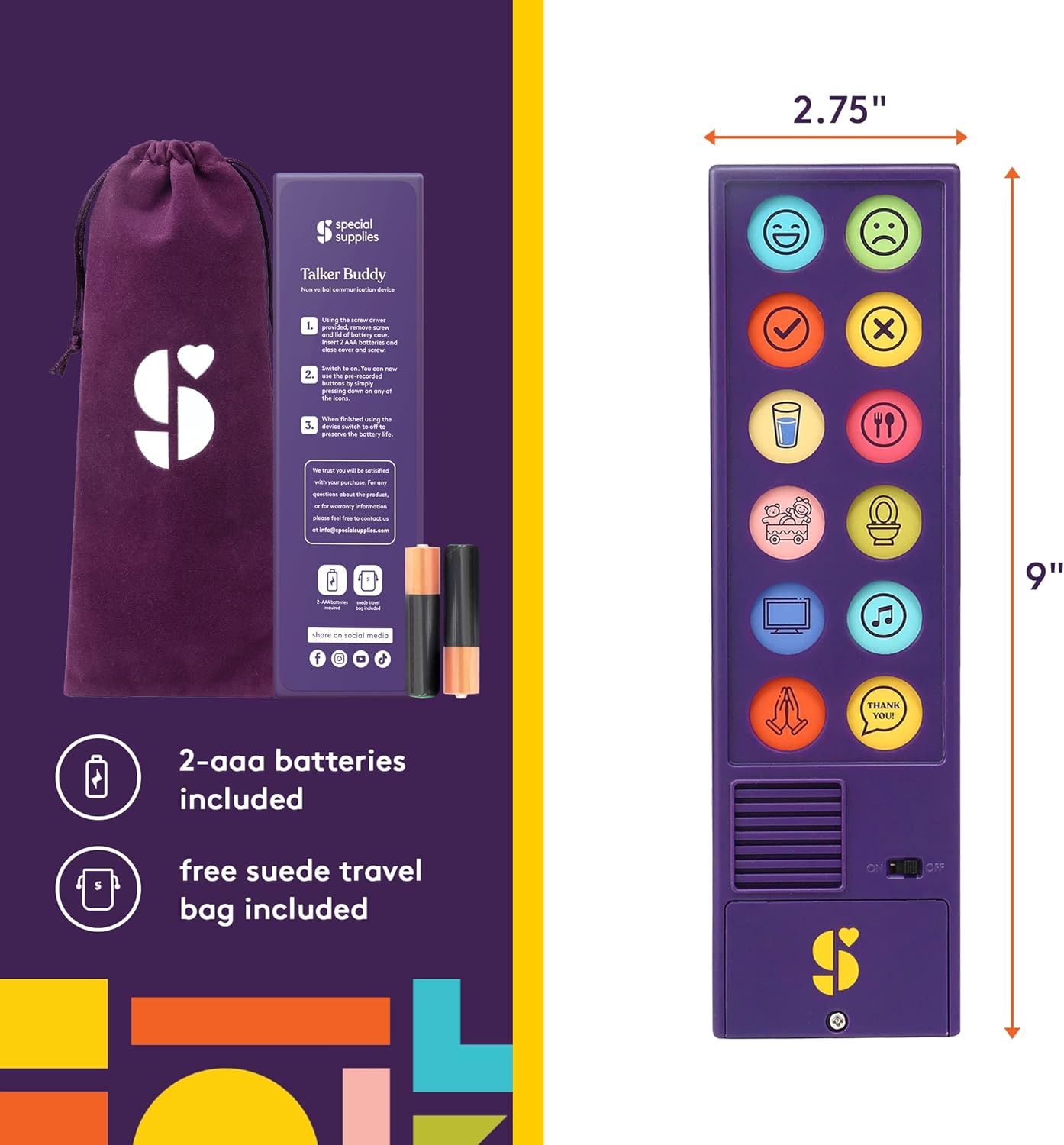
Imagine you’re three sessions into a new client — a seven-year-old with cerebral palsy who can reliably isolate one finger on his right hand and has about 30 functional words in context, but whose family is asking whether it’s already time for a dedicated speech-generating device. You’ve ruled out high-tech eye-gaze because motor control is still consolidating. Now you’re staring at a catalog page that runs from a $25 big-button recording switch all the way to a $1,200 mid-range AAC tablet overlay system, and the funding coordinator wants a justification letter by Friday. That gap — between “something button-based” and the right button-based device at the right stage — is what this guide is built to close.
AAC (Augmentative and Alternative Communication) is the umbrella term for any tool that helps someone communicate when speech alone isn’t enough. “Button-based” AAC specifically means devices operated by pressing a physical key, switch, or symbol tile — no eye-tracking, no voice recognition, no complex motor sequence required. At their simplest these are single-message recordable buttons. At their most sophisticated they are robust dedicated devices with multi-level vocabulary systems accessed through a grid of physical or touch-emulated keys. The activation force (how hard you have to press) and the vocabulary architecture (how many messages are reachable and how) are the two variables that determine whether a device fits a user today and scales with them tomorrow.
| EDITOR'S PICK[MibbyTalk AAC Device for Autism](https://www.amazon.com/dp/B0FY3B1M7G?tag=greenflower20-20)… | Mid-tierAAC Device for Autism & Nonverb… | Budget pick[Special Supplies AAC Communicat](https://www.amazon.com/dp/B0FQQPW1MW?tag=greenflower20-20)… | |
|---|---|---|---|
| Preset buttons | 32 | 36 | — |
| Recordable | 11 | 6 | — |
| Stickers incl. | ✓ | — | — |
| Sensory feature | — | ✓ | — |
| Carry bag | — | — | ✓ |
| Price | $39.95 | $19.99 | $13.99 |
| See on Amazon → | See on Amazon → | See on Amazon → |
Why Activation Force Is the First Spec to Pin Down
Most practitioners learn vocabulary size before they learn activation force, which is backwards from an access standpoint. If a user cannot activate the device reliably and without fatigue, vocabulary depth is irrelevant.
Activation force is measured in grams-force (gf) — the amount of downward pressure required to register a button press. Published spec sheets for dedicated AAC hardware typically list this; consumer-grade tablets running AAC apps generally do not, which is one underappreciated argument for purpose-built devices at the clinical tier.
By the numbers:
- Standard membrane buttons on consumer devices: ~150–400 gf
- Low-force switches designed for AAC access (e.g., Ablenet Specs Switch): ~85–100 gf
- Ultra-low-force options for users with minimal motor control: ~30–60 gf
- Recommended trial threshold before finalizing device selection (per ASHA clinical guidance): minimum 20 reliable activations across 3 sessions
Per ASHA’s AAC clinical practice portal, the goal at access assessment is “reliable, efficient, and fatigue-free activation across a communicative context,” not just successful activation under ideal conditions. That distinction matters when writing the justification letter: demonstrating consistent performance across three varied sessions is stronger evidence than a single-session trial.
For users with ALS, progressive fine-motor decline means you’re selecting for a trajectory, not a snapshot. A device with easily adjustable activation force — or one that couples straightforwardly to an external switch — extends the useful life of the funding decision considerably. ABLEDATA’s device fact sheets flag this explicitly as a clinical consideration when the etiology is degenerative.
Vocabulary Architecture: Where Stage-Matching Actually Happens
Once access is confirmed, vocabulary architecture becomes the central purchasing variable. Button-based AAC devices fall into three functional tiers, and the mapping from clinical stage to tier is relatively reliable.
Tier 1: Single-Message and Sequential Devices ($25–$150)
Devices like the BigMack (AbleNet) or Step-by-Step communicator record one message or a short linear sequence of messages per device. These are appropriate during initial AAC introduction, cause-effect exploration, or when a user is demonstrating intentional communication for the first time.
Across aggregated clinical reviews on platforms indexed by ATIA, SLPs consistently note that single-message devices serve an assessment and motivation function more than a long-term communication function — they build the concept that pressing something produces a communicative result. That’s valuable, but it’s a bridge, not a destination.
Key trade-offs here:
- Pro: Low activation force versions are readily available; no programming complexity; durable enough for classroom environments.
- Con: Vocabulary ceiling is immediate; families sometimes interpret single-device success as readiness for full AAC when it reflects access readiness, which is a narrower claim.
Funding note: These are frequently purchased outright by families or covered under school district AT budgets. Medicaid and private insurance rarely engage at this price point — the paperwork cost exceeds device cost — so don’t burn clinical documentation capital pursuing insurance for a $75 device.
Tier 2: Multi-Level Static Grid Devices ($200–$800)
This is the segment with the widest variance in clinical fit. Devices like the GoTalk 9+ or 20+ (Attainment Company) and the SuperTalker Progressive (AbleNet) offer multiple pages or levels accessible through a dedicated level-change button, with a fixed grid of symbol-backed cells per level.
The critical distinction from tier 1 is representational depth: a user can now access categorically organized vocabulary — core words on one level, activity-specific fringe vocabulary on another. ASHA’s practice guidance on AAC for developing communicators specifically highlights the shift from requesting only to commenting, protesting, and initiating as the stage where multi-level devices become clinically appropriate.
Activation force profiles in this tier vary meaningfully by device. The GoTalk series uses standard membrane buttons; some users with spasticity or limited isolated finger movement find them workable, while others do not. Published spec sheets for these devices list button dimensions and tactile feedback profiles but not always explicit gram-force ratings — a gap that ATIA has flagged in its evidence practice briefs as an ongoing transparency issue in the mid-market AAC segment.
Decision frame for Tier 2: If your client has demonstrated intentional multi-turn exchanges (not just requesting), has at least 20–50 core words in context, and has a reliable activation pattern, the GoTalk 20+ at roughly $225–$280 (street price, mid-2026) is a rational trialing device. It is not a long-term device for most users — the non-programmable symbol layout limits vocabulary personalization — but it can sustain communication while more robust funding is pursued.
For users who will clearly need robust, open-ended vocabulary systems within 12–18 months, some practitioners argue that time spent at Tier 2 is time lost. The counterargument, which has clinical merit, is that demonstrating reliable multi-level access on a simpler device strengthens the medical necessity narrative for a Tier 3 authorization.
Tier 3: Robust Dedicated AAC Devices with Button or Touch Access ($600–$1,800+)
This is where the purchasing decision carries the most consequence and the most funding complexity. Devices in this tier — including the PRC-Saltillo Nova Chat series, the Tobii Dynavox T-series accessed via touch or external switch, and the Lingraphica TalkPath family — offer fully programmable vocabulary systems, often built on evidence-based language frameworks like LAMP (Language Acquisition through Motor Planning) or Unity.
These devices are typically running robust AAC software (PRC-Saltillo’s Access software suite, Tobii Dynavox’s Snap + Core First or TD Snap) on hardened hardware with cases rated for drop and moisture exposure. Activation force at this tier is managed through software sensitivity settings and, critically, through external switch integration — meaning a single Bluetooth or wired switch plugged into the device can serve as the sole access method.
Per ABLEDATA’s device documentation, most Tier 3 devices from major manufacturers support scanning (where items are highlighted automatically and the user selects by activating a switch at the right moment), direct selection (touching or pressing each key directly), and partner-assisted scanning. That flexibility is worth naming explicitly in the funding letter because it demonstrates long-term utility even if access needs change.
The math that matters for funding authorization:
A Medicaid-funded Tobii Dynavox I-Series with mounting hardware lands at roughly $7,500–$9,000 at clinical billing rates. A Nova Chat 10 with a 12-month warranty and carrying case typically runs $1,200–$1,600 through educational and Medicaid channels. For a school-aged user with a clear prognosis for independent robust communication, the I-Series may be justified by gaze-access needs. For a user with functional hand control, submitting the Nova Chat 10 through an educational AT process — with a demonstration of reliable button access — can close funding in weeks rather than the 4–6 months a full Medicaid SGD (Speech Generating Device) authorization sometimes requires.
Funding Pathways: Matching the Device Tier to the Authorization Route
The Understood.org overview of AAC funding confirms what most SLPs learn by trial and error: funding route should be determined alongside device selection, not after it.
Quick routing guide:
- Tier 1 ($25–$150): School district AT budget, family purchase, state AT lending library (most states operate these through ATIA-affiliated programs). Do not pursue Medicaid.
- Tier 2 ($200–$800): School district AT, some state Medicaid waiver programs (varies significantly by state), occasional private insurance with a brief letter of medical necessity. ATIA maintains a state-by-state funding resource directory that is worth bookmarking.
- Tier 3 ($600–$1,800): Medicaid fee-for-service (requires formal SGD evaluation documentation, typically from an SLP with AAC specialist credentials), private insurance with prior authorization, IDEA funding through IEP process for school-aged users, state vocational rehabilitation for adults with employment-related communication needs.
One practical note: some Tier 3 manufacturers — PRC-Saltillo and Tobii Dynavox prominently — maintain their own funding support teams who will help navigate authorization paperwork. This is not altruism; it’s a sales support function. But the practical assistance is real and worth using, particularly for practitioners who are newer to the SGD authorization process.
If X, Then Y: The Decision Rules
After working through activation force, vocabulary architecture, and funding route, the decision usually resolves to one of four patterns:
If the user is at cause-effect or early intentional communication stage and motor access is unconfirmed → then start with a Tier 1 single-message device from an AT lending library (free trial, no funding burn) while conducting formal access assessment.
If the user has reliable single-button access, 20–50 core words, and is demonstrating multi-turn exchanges → then trial a Tier 2 multi-level device. If the funding window for Tier 3 is more than 6 months out, purchase Tier 2 rather than waiting. Communication doesn’t pause for authorizations.
If the user needs a robust open-ended vocabulary system and has functional hand or finger access with no degenerative prognosis → then target Tier 3 in the $600–$1,200 range (Nova Chat class) through school or Medicaid waiver, and document button-access reliability across three sessions as the clinical cornerstone.
If the user has progressive motor decline (ALS, progressive MS) or access needs that are likely to shift toward scanning or alternative access within 24 months → then move directly to Tier 3 hardware that supports switch scanning, and initiate Medicaid SGD authorization now. The lead time on full authorization will consume most of the window before access changes.
The button-based AAC market in 2026 is more evidence-dense than it was five years ago, which means the justification for any tier choice can be grounded in published outcomes rather than clinical intuition alone. Per ASHA’s updated AAC evidence map and ATIA’s practice briefs, device trials of adequate length (minimum three sessions across varied contexts) and documented motor access profiles are the two variables that most reliably predict successful authorization and long-term device adoption. Build those into your intake process, and the Friday funding letter practically writes itself.