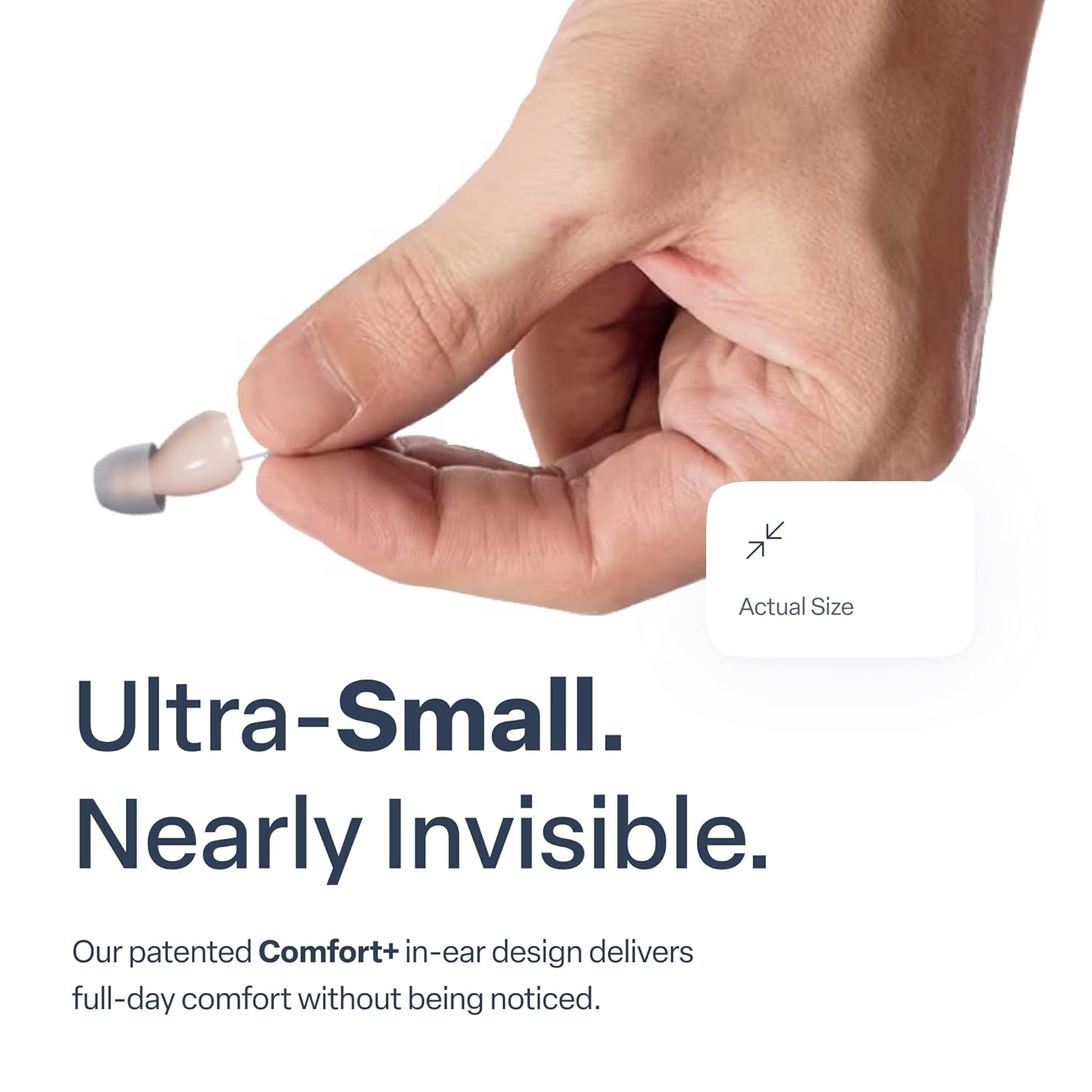
Imagine you’ve been turning up the TV for two years. Friends have started repeating themselves without being asked. You’ve quietly googled “hearing aids without a doctor’s appointment” at 11 p.m. and found a confusing wall of brand names, decibel figures, and price tags that swing from $200 to $8,000. You’re not imagining the confusion — the hearing aid market went through a genuine structural change in 2022 when the FDA (the U.S. Food and Drug Administration) created a new category called over-the-counter, or OTC, hearing aids: devices that adults 18 and older with mild to moderate hearing loss can buy directly, without a prescription or a clinic visit. That single rule change cracked open a market that had been gated by expensive audiologist appointments for decades. The promise is real, but so are the trade-offs — especially in the $200–$999 band where most first-time buyers land.
This guide is written for practitioners and informed buyers who already know the basic OTC/prescription divide and want a clear decision framework: which devices in this tier actually deliver, what the spec sheets don’t tell you, and when the math genuinely favors stepping up (or stepping back).
| EDITOR'S PICK[BlaidsX Neuro Hearing Aids](https://www.amazon.com/dp/B0GQGLMG3K?tag=greenflower20-20) | Mid-tier[Oricle Standard 2.0 Hearing Aid](https://www.amazon.com/dp/B0DMBX8RZT?tag=greenflower20-20)… | Budget pick[Audien Atom One OTC Hearing Aid](https://www.amazon.com/dp/B0F5G5XQTP?tag=greenflower20-20)… | |
|---|---|---|---|
| Bluetooth | ✓ | — | — |
| App support | ✓ | — | — |
| Noise cancel | ✓ | ✓ | — |
| Charging case | — | ✓ | — |
| DSP channels | 32 | — | — |
| Price | $399.00 | $99.99 | $88.00 |
| See on Amazon → | See on Amazon → | See on Amazon → |
What “Mild to Moderate” Actually Means — and Why It’s the Pivotal Variable
The FDA’s OTC rule applies to adults with mild to moderate hearing loss, defined clinically as a hearing threshold in the range of roughly 26–55 dB HL (decibels hearing level) across the speech-frequency range. Per the American Speech-Language-Hearing Association’s guidance on OTC hearing aids (asha.org, 2023), this covers a large share of adults who notice difficulty with conversation in noise or group settings, but who can still follow one-on-one speech in quiet.
The reason this matters practically: OTC devices are not gain-limited in marketing language, but they are gain-limited in engineering reality. Most devices in this price band deliver a maximum gain of 25–30 dB. That’s appropriate for mild loss. If your actual loss edges into the moderate-to-severe range — threshold above 55 dB HL — the physics run out before your comprehension does. Consumer Reports’ evaluations of OTC hearing aids (consumerreports.org, updated 2025) consistently flag this as the most common source of buyer dissatisfaction: the device isn’t broken, the loss is simply beyond its design envelope.
The practitioner implication: if you’re advising someone who has never had an audiogram and who reports significant difficulty in quiet one-on-one settings (not just noise), the OTC path carries real clinical risk of under-fitting. The Hearing Loss Association of America (hearingloss.org) recommends a baseline audiogram before any OTC purchase for exactly this reason — not to gatekeep, but because a $25 hearing test at a Costco audiology counter can prevent a $500 return.
The Mid-Range Tier: What $300–$999 Actually Buys You
By the Numbers (mid-range OTC, May 2026 market)
| Price band | Typical features | What you give up vs. prescription |
|---|---|---|
| $200–$399 | App-adjustable EQ, rechargeable, basic noise reduction | No directional microphone steering, limited hearing profile customization |
| $400–$699 | Directional mics, Bluetooth audio streaming, self-fit testing | Fewer processing channels (4–8 vs. 16–24), no real-ear measurement |
| $700–$999 | Multi-environment programs, telecoil option on some models, better processor | Still no professional REM verification, 1-year warranty typical |
The standout architectural difference between OTC and prescription devices is real-ear measurement (REM) — an in-clinic process where a probe microphone is placed in the ear canal to verify that the device is actually delivering the prescribed gain at the eardrum. Without REM, you’re relying on the device’s self-fit algorithm, which uses the user’s reported hearing difficulties and a brief in-app tone test to estimate the right amplification curve. Wirecutter’s ongoing OTC hearing aid coverage (wirecutter.com, updated 2025) notes that self-fit algorithms have improved substantially since 2022 but remain a probabilistic estimate rather than a verified measurement — which is fine for many mild-loss users and genuinely risky for anyone near the moderate-severe boundary.
The Devices Worth Knowing in This Band
Sony CRE-10 and CRE-20 (~$200–$999 range, depending on model and retailer): Sony’s OTC line draws consistent praise across aggregated owner reviews for build quality and the clarity of the companion app’s self-fitting flow. The CRE-20 adds Bluetooth streaming — a meaningful quality-of-life upgrade for phone and media use. Owners report the fit is comfortable for extended wear, though the open-dome design (the small silicone tip that sits loosely in the ear canal, leaving the canal partly open) means less low-frequency amplification, which doesn’t suit everyone.
Jabra Enhance Select 500 series (~$800–$999): Jabra’s partnership with GN Hearing brings prescription-adjacent processing into the OTC shell. Published specs credit the Enhance 500 with up to 12 processing channels and directional microphone steering — meaningfully above the entry-tier baseline. Aggregated user reviews note particularly strong performance in restaurant-level noise. Jabra also offers remote audiologist support as an optional add-on, which is the product’s most distinctive feature: you get professional fine-tuning without an in-person visit. That hybrid model is worth naming explicitly when counseling clients who are on the fence between OTC and prescription.
Lexie Lumen (~$799): Backed by Bose’s acoustic research heritage (though Bose exited direct OTC retail in 2023, Lexie licenses the underlying technology), the Lexie Lumen earns strong marks in Consumer Reports’ testing protocols for speech-in-noise performance relative to its price tier. Owners consistently report the app is intuitive for self-adjustment, which matters because the OTC value proposition collapses if users don’t actually tune the device to their environment.
Eargo 7 (~$999): Eargo’s in-canal design (the device sits fully inside the ear canal rather than behind the ear) addresses a real psychosocial barrier — many adults resist visible hearing aids. Published specs put the Eargo 7 at 16-band processing, which is competitive with lower-end prescription devices. The trade-off: the in-canal form factor limits battery size, so rechargeable cycle life is shorter, and physical manipulation is harder for users with reduced finger dexterity. Worth flagging for any client managing fine motor limitations.
The Trade-Offs No Spec Sheet Names
Stigma and Visibility
This is not a clinical parameter, but it drives purchasing decisions more than almost any other factor. Consumer Reports’ 2025 survey data notes that appearance remains a top-three barrier to hearing aid adoption for adults under 65. The OTC market has partially addressed this with in-canal and receiver-in-canal designs, but the practitioner reality is: if a client buys a device they won’t wear, the clinical outcome is zero regardless of the spec sheet. Budget time in the counseling conversation for this.
Bluetooth Ecosystem Friction
Mid-range OTC devices increasingly advertise Bluetooth audio streaming as a premium feature. The genuine caveat: Bluetooth implementation quality varies significantly. Owners of several sub-$600 OTC models report connection drops, latency in video playback, and inconsistent pairing across Android vs. iOS. The $700–$999 band generally resolves this more reliably, but “Bluetooth-enabled” on the box is not a warranty of smooth daily use.
Telecoil Access — the Frequently Skipped Feature
A telecoil (also called a T-coil) is a small copper coil inside a hearing aid that picks up the magnetic signal broadcast by a hearing loop — the induction loop systems increasingly installed in theaters, houses of worship, airports, and classrooms. When a telecoil-equipped hearing aid connects to a hearing loop, the user receives the audio signal directly, bypassing room noise entirely. Per the Hearing Loss Association of America’s OTC resources (hearingloss.org), most OTC devices at this price tier do not include a telecoil — it adds cost and physical size that manufacturers have largely cut from consumer-grade devices. For any client who regularly uses venues with installed loop systems, this is a decisive gap. It’s worth asking explicitly: “Do you attend religious services, live performances, or take public transit?” A “yes” to any of those in a telecoil-equipped venue tips the math toward a prescription device.
The Funding Conversation You Can’t Skip
OTC hearing aids sit in an awkward insurance zone. Medicare Part B does not cover hearing aids, OTC or prescription, as of mid-2026 — though this is an active legislative debate. Medicaid coverage varies by state; several states do cover hearing aids for adults, typically through prescription pathways only, which means OTC devices may be ineligible even where hearing aid benefits exist. The Hearing Loss Association of America maintains a state-by-state coverage summary (hearingloss.org) worth bookmarking for client conversations.
FSA and HSA eligibility is the practical bright spot: OTC hearing aids qualify as eligible medical expenses under IRS guidance for Flexible Spending Accounts and Health Savings Accounts. For a client with $800 in an FSA facing a year-end spend-down deadline, that changes the effective price substantially. Retailers including Best Buy and major pharmacy chains now stock OTC devices specifically to serve this FSA/HSA pipeline — worth noting for clients who haven’t connected those dots.
Vocational Rehabilitation is underused in this market. Adults whose hearing loss affects their ability to work may qualify for state VR funding that covers hearing devices — sometimes at the prescription level — regardless of whether they start with an OTC device. If a client is working-age and employed, VR is worth surfacing even if the conversation started with a $600 OTC inquiry.
The Decision Rule
Here’s the honest if/then framework for the mid-range OTC tier:
If the person has confirmed mild loss (or strong reason to believe it based on symptom pattern) + can navigate a smartphone app + doesn’t use hearing loop venues regularly + is cost-sensitive or insurance-uninsured → OTC in the $400–$999 band is a genuinely reasonable first step. The Jabra Enhance 500 or Lexie Lumen represent the ceiling of this tier in terms of documented performance.
If the person has never had an audiogram + reports difficulty in quiet settings + is over 60 with potential for moderate-to-severe loss + or has any neurological or ear health complexity → recommend an audiogram first, even a low-cost one. The OTC path isn’t closed, but the risk of buying a $900 device that doesn’t have enough gain is too high to skip that step.
If the person regularly attends telecoil-equipped venues + or has dexterity or cognitive limitations that make app self-fitting difficult → the OTC tier doesn’t serve them well. The conversation should shift toward prescription devices, VR funding, and whether the $1,500–$3,500 prescription band is reachable through FSA/HSA, state Medicaid, or VR.
The OTC revolution is real. So is its ceiling. Knowing exactly where that ceiling is — for each specific person, in their specific listening environments, with their specific insurance and savings profile — is the practitioner’s job that no algorithm has replaced.