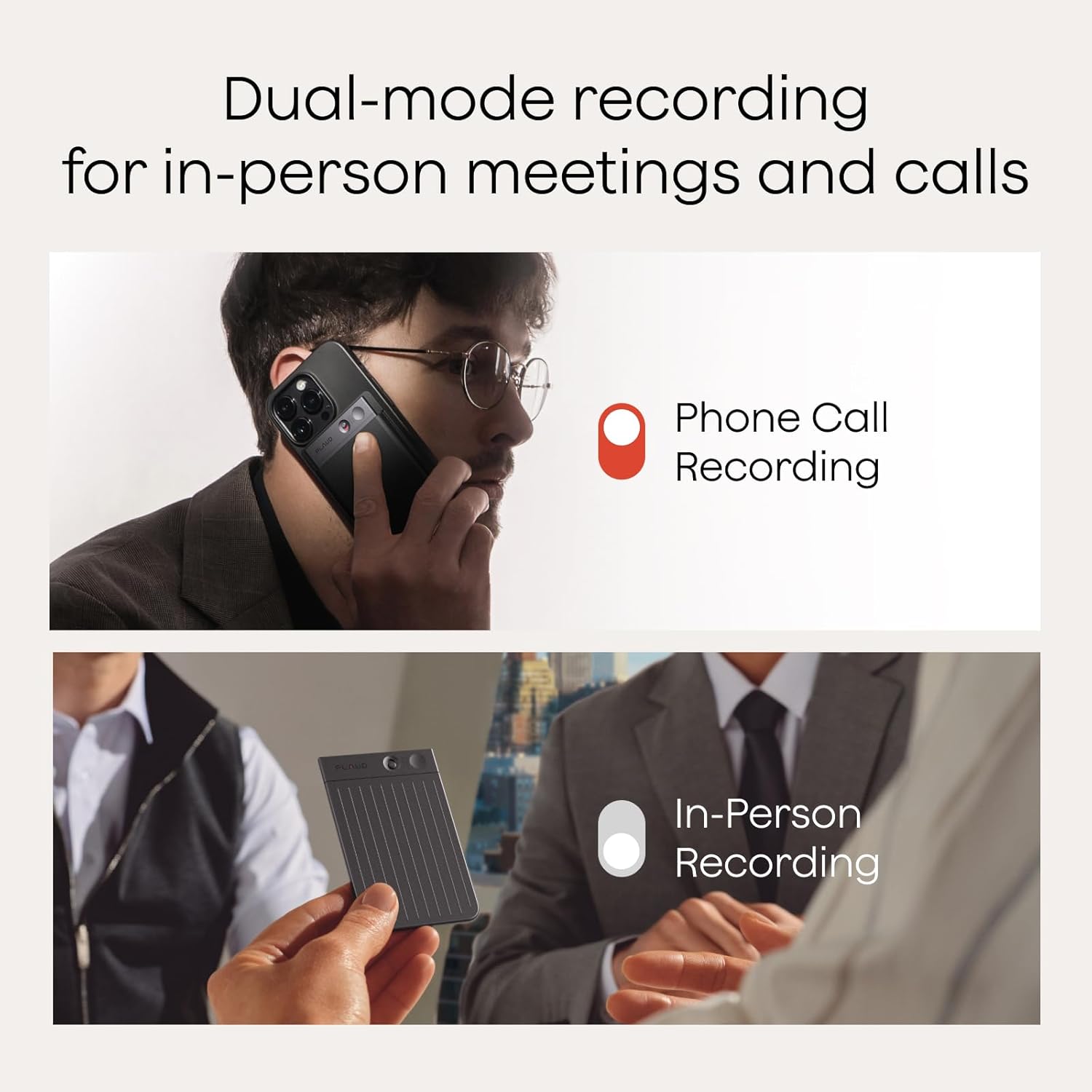
Imagine you’ve just left a neurologist’s appointment. The doctor covered medication changes, a referral to a physiatrist, and three follow-up instructions. You understood it all in the room. Forty minutes later, back in the car, the details are gone — not because you weren’t paying attention, but because acquired brain injury (ABI) or post-concussive cognitive fatigue (the mental exhaustion that many brain injury survivors describe as a “fog” that descends without warning) disrupts the brain’s ability to transfer information from short-term awareness into reliable memory. AI voice recorders are small devices — roughly the size of a credit card or a thumb drive — that record audio and then use artificial intelligence to convert that audio into a written transcript automatically, often identifying which person said what. They aren’t a new category, but the current generation has become genuinely useful for people navigating cognitive disability in high-stakes, multi-speaker environments like clinical appointments, care-team meetings, and family planning conversations. This guide tells you which features actually matter for that use case, where the real-world tradeoffs land, and how to avoid the pitfalls that cost users time and trust.
Why This Product Category Is Different for ABI and Cognitive Fatigue Users
For most productivity users, an AI voice recorder is a convenience. For someone managing the cognitive sequelae (downstream effects) of traumatic brain injury, stroke, or acquired brain injury — including fatigue, working-memory deficits, and processing-speed changes — it is closer to a prosthetic. ABLEDATA’s cognitive aids listings acknowledge this explicitly, categorizing audio and transcription aids under assistive technology for memory and executive-function support, not lifestyle tech.
That distinction changes the evaluation criteria entirely.
Working memory support, not just note-taking. Per the Understood.org overview of working memory, people with reduced working-memory capacity cannot reliably hold multi-step instructions in mind long enough to act on them. A transcript is not a convenience in that context — it is the difference between following a discharge plan correctly or not. One verified buyer of a budget AI recorder in this category stated plainly in a public review that the device prevented job loss due to cognitive difficulties from a health diagnosis. That is the stakes tier we are evaluating at.
Speaker identification in multi-provider environments. A neurology follow-up or an IEP (Individualized Education Program) meeting may involve a neurologist, a rehabilitation nurse, a social worker, and a family caregiver speaking in sequence. Knowing who said what is clinically meaningful — not just for recall, but for follow-up accountability. The ability to label transcript segments by speaker (often called “diarization” in the technical literature, meaning the system distinguishes and names different voices) is not a premium feature for ABI users; it is a baseline requirement.
Accessibility of the output. An occupational therapist or SLP advising a client on this purchase must ask: can this person review their recordings independently? If the transcript lives only inside a proprietary app that requires a login, multi-step navigation, and reliable internet access, the tool will fail users who have limited technical support networks — particularly those in rural areas or with additional motor or vision impairments.
The Devices Worth Knowing in 2026
Plaud Note and Plaud Note Pro
The Plaud Note Pro has become the reference point for ABI users discussing this category in assistive technology circles, and for good reason. A publicly documented review from a traumatic brain injury and spinal column injury survivor describes specific use cases that map directly to the clinical profile: capturing physician appointments, family planning conversations, and personal tracking — not productivity sprints, but the slow, high-stakes information environments that cognitive fatigue makes dangerous to navigate on memory alone.
The feature that reviewers in this population return to most consistently is speaker identification. The Plaud Note Pro’s diarization is reported by owners as reliable enough to distinguish a primary care physician from a specialist when both are recorded in the same session — a meaningful capability for anyone whose appointment involves more than one provider.
Subscription structure: This matters for budget planning. The Plaud Note requires a subscription for ongoing AI transcription. The base hardware cost does not include unlimited transcription; owners report that the free tier covers a limited monthly transcription allowance, and clinical-volume users — those capturing multiple appointments and care conversations per week — will hit that ceiling. Budget accordingly, and treat the device cost and the annual subscription as a combined line item.
App dependency: This is the single most important operational risk in the Plaud ecosystem. One documented 1-star review in the competitive set — not specifically the Plaud, but representative of the category — was written specifically because recordings cannot be reviewed without the proprietary app and are stored in a format that requires that app to open. For an ABI user who changes phones, loses access to an account, or simply needs a caregiver to access a recording on a different device, this is not a minor inconvenience. It is an accessibility barrier. Evaluate whether offline review or export to a standard audio format (MP3, WAV) is supported before committing.
Budget Tier: GPT-Powered Compact Recorders (including devices marketed as “GPT-5.2” class)
The lower end of the AI recorder market — devices typically under $100 — has expanded rapidly. One verified buyer in this tier identified themselves as using the device specifically because of cognitive challenges from a health diagnosis, and described it as having preserved their employment. That outcome is worth naming, because it challenges the assumption that clinical-grade use cases require premium hardware.
The honest tradeoff: budget devices in this tier typically offer less accurate diarization, shorter battery life, and less polished transcript editing interfaces. For a single-speaker use case — recording a solo appointment with one provider — the accuracy gap may be acceptable. For complex multi-speaker meetings, the gap widens.
iFLYTEK SR Series
The iFLYTEK recorders are frequently marketed on the strength of AI transcription accuracy claims. A detailed 1-star review from a courtroom user — a controlled, low-noise environment where accuracy should be maximized — documented transcription failures that directly contradicted the marketing. That experience should calibrate expectations: marketing claims about AI accuracy in this category are not independently verified, and ABI users relying on these transcripts for medical decision-making need to treat accuracy claims skeptically until they have run their own test recordings in their actual environments. Ask: does the device let you run a short test before committing to a clinical recording? If not, that itself is a risk signal.
Decision Frame: Matching Device to Functional Profile
| If your primary use case is… | Then prioritize… | Tradeoff to accept |
|---|---|---|
| Multi-provider clinical appointments | Speaker diarization + export flexibility | Higher cost, likely subscription |
| Single-provider sessions + job support | Budget tier with good single-speaker accuracy | Weaker diarization |
| Low-tech-support user or shared device access | Offline review capability + standard file formats | May sacrifice AI feature depth |
| High-volume use (daily recordings) | Generous or unlimited transcription tier | Annual subscription cost adds up |
The American Occupational Therapy Association’s Occupational Therapy Practice Framework emphasizes matching assistive technology to the person’s environment and occupational demands — not to a generalized “best” device. That framework applies directly here: the right recorder for a person attending three specialist appointments per week in a major medical center is not the same device as the right recorder for someone capturing a weekly check-in call with a case manager.
What to Ask Before Any Purchase
The ATIA’s assistive technology evaluation guidance recommends a feature-matching checklist before purchase. For AI voice recorders in the ABI context, that checklist should include:
- Can I review transcripts without the app? If the answer is no, plan for app access to be a dependency for the device’s useful life.
- Can I export the transcript as plain text or PDF? This matters for sharing with care teams or filing in a personal health record.
- What happens to my recordings if the company shuts down or discontinues the service? Cloud-dependent recorders carry platform-risk. A device that stores audio locally in a standard format survives company changes; one that stores only in a proprietary cloud does not.
- Is there a free trial period for the transcription subscription? Testing accuracy in your actual acoustic environment — your clinic’s exam room, your workplace — before committing is the only reliable way to evaluate real-world performance.
- Does the device support offline recording? Almost all do, but some require connectivity to trigger AI processing. If you are recording in a basement clinic with poor signal, this matters.
Frequently Asked Questions
Can I use an AI voice recorder to capture my doctor’s appointments and get an accurate transcript? Yes — this is one of the most documented real-world use cases in current owner reviews, particularly among people managing cognitive fatigue or memory deficits from brain injury. Most facilities do not prohibit recording when you inform the provider. Accuracy varies by device and acoustic environment; single-provider, low-noise settings produce the best results. Always verify a short test recording before relying on a transcript for clinical decisions.
Does the Plaud Note require a monthly subscription to transcribe recordings? Yes. The Plaud Note and Plaud Note Pro offer a free transcription allowance, but owners report that high-volume users — multiple long recordings per week — will exceed it. The subscription cost is a real budget line item separate from hardware cost.
Will the transcription work if multiple people are speaking — can it identify who said what? Higher-end devices including the Plaud Note Pro support speaker diarization, which labels transcript segments by speaker. Owners consistently praise this feature for clinical appointment use. Budget-tier devices handle this less reliably. If knowing who said what is clinically important (medication instructions, for example), prioritize a device with documented diarization capability.
Can I review my recordings without using the app on my phone? This depends entirely on the device. Some recorders allow playback directly on the hardware and export to standard audio files; others store recordings in a format that requires the proprietary app. At least one documented 1-star review in this category was written specifically because of this limitation. Verify before purchasing — this is a non-negotiable accessibility issue for users with limited technical support.
How accurate is AI transcription in real-world settings — is it good enough to rely on for medical notes? Accuracy varies significantly by device, acoustic environment, speaker accent, and recording distance. The iFLYTEK courtroom review is a useful calibration point: even in a controlled, low-noise environment, one device failed to meet the accuracy implied by its marketing. Treat any device’s accuracy claims skeptically, run your own test recording in your actual environment, and treat transcripts as a strong memory aid rather than a verbatim legal record without review.
What happens to my recordings if the company discontinues the app or the service? If recordings are stored only in a proprietary cloud or format, discontinuation of the service likely means loss of access. Devices that store audio locally in standard formats (MP3, WAV) and allow local export are meaningfully more durable. For long-term personal health records or legal documentation, local storage and export capability are not optional features.
The Bottom Line
If the person you’re advising — or you yourself — attends appointments where multi-speaker accuracy matters and independent transcript access is a functional requirement, the Plaud Note Pro is the most credibly documented option in this use case as of mid-2026, with the subscription cost and app-dependency risk both priced into the decision. If budget is the binding constraint and the primary use is single-speaker recording for job support or personal tracking, a GPT-tier budget device has real-world evidence behind it — one documented user credited it with preserving their employment. For either path, demand a test window, export your transcripts to a format you own, and never treat any AI transcript as final without a review pass. The tool supports memory; it doesn’t replace judgment.