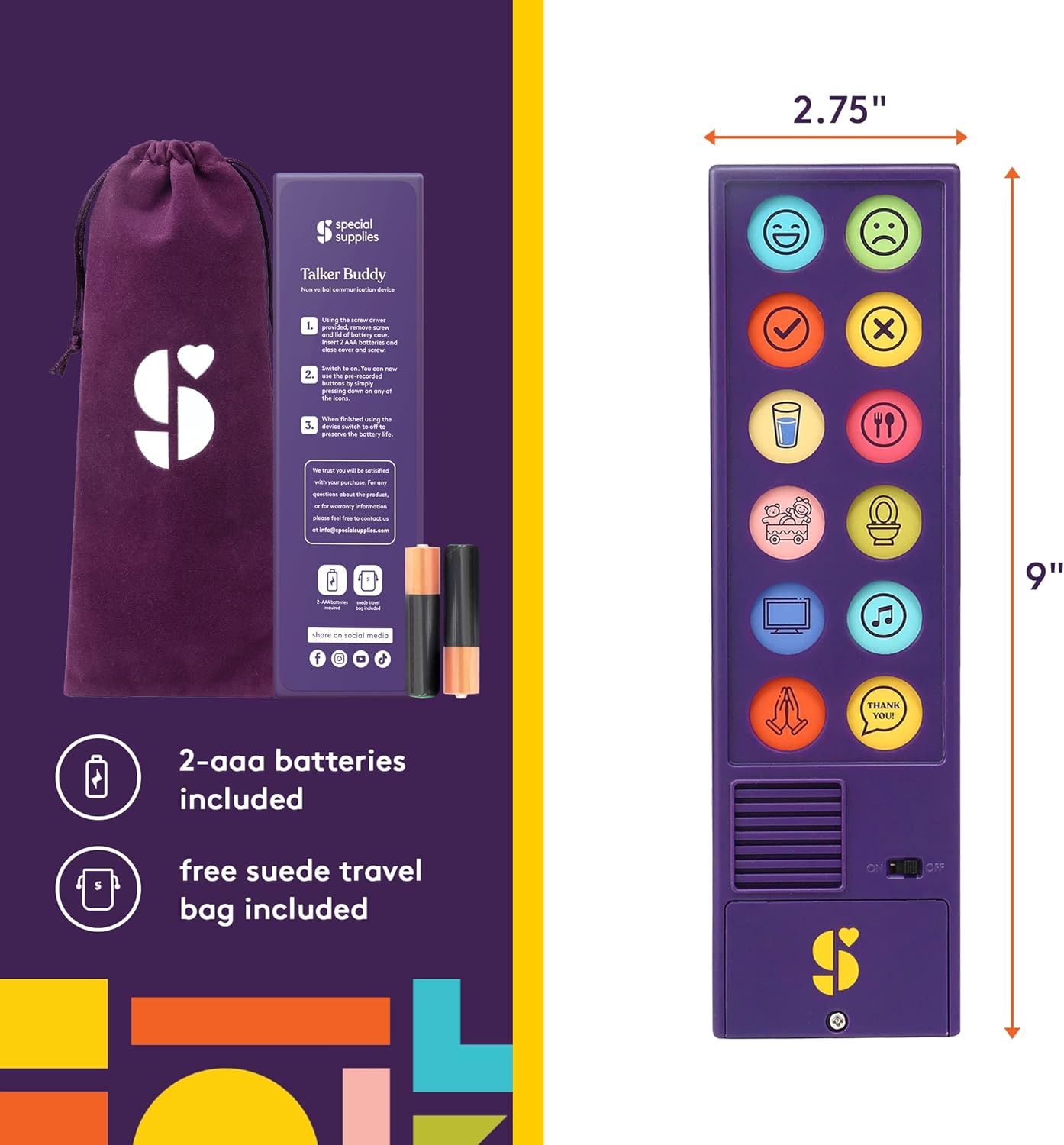
Imagine you’re a paraprofessional supporting a six-year-old who has just started using picture symbols to communicate — and you need something on the table tomorrow, before the school’s AAC evaluation is even scheduled. Or you’re a parent who watched your child ignore an iPad app entirely because the iPad also plays games, and you’re done fighting that battle. You’ve landed on “recordable button devices” — physical gadgets with big, pressable buttons that play back a voice message you recorded yourself. These are not the $3,500 Tobii Dynavox I-Series devices you’ve read about. They sit at the opposite end of the market: plastic, simple, powered by AA batteries, and priced under $80. The question isn’t whether they’re as powerful as clinical-grade AAC systems — they’re not, and no one should pretend otherwise. The question is whether they’re useful, who they’re useful for, and which specific products are worth the money right now.
This guide is built for the practitioner who already knows what AAC (augmentative and alternative communication) is, has a real user in mind, and needs a decision frame — not a glossary. If you’re advising a family or purchasing for a classroom, read on.
The Case for Physical Over Digital (and Where It Breaks Down)
The most instructive purchase pattern in this product category — documented consistently across caregiver reviews and parent forums — is the family that explicitly chose a physical recordable device over a tablet app because their child had learned to associate the iPad with entertainment. This is not a niche concern. It’s a documented behavioral accommodation, and it deserves to be treated as a legitimate clinical consideration rather than a workaround.
Understood.org’s explainer on AAC notes that the goal of any AAC system is to support communication across all environments and partners. A device that competes with YouTube for a child’s attention isn’t meeting that bar. When a child reaches for a physical button and hears a voice say “I want more,” that action-outcome pairing is clean. There’s no notification badge in the corner.
That said, physical button devices have hard ceilings. The ASHA AAC practice portal is clear that robust, growth-capable AAC systems need to scale with the user’s language development. A four-button device will not get a child to full sentence construction. The honest framing: recordable button devices are genuine starter tools and specific-context supports, not long-term primary communication systems for most users. If you’re purchasing in the under-$80 bracket, you should know what you’re getting — and what you’ll outgrow.
By the Numbers
| Device profile | Button count | Recording time per button | Approx. price tier | Known issue |
|---|---|---|---|---|
| Entry single-button (e.g., AbleNet Big Mack style) | 1 | 20–75 sec | $25–$45 | Limited vocabulary |
| Mid-range multi-button (e.g., Brightway 60-button) | 60 | 10 sec | $50–$70 | Auto-shutoff behavior |
| Recordable communication book (e.g., ZYLIRA-style) | 30–60 | varies | $30–$55 | Documented battery/function failures |
| Teacher classroom 4-pack | 4 units × varies | varies | $60–$80 | Durability under daily use |
(Price tiers reflect May 2026 market conditions for devices in the recordable-button AAC category available through mainstream retail channels.)
Device-by-Device Reality Check: What the Evidence Shows
AbleNet BigMack and Single-Button Communicators
Single-button devices are the entry point of the entry point. A child presses one large button; a recorded message plays. ABLEDATA’s AAC product listings include AbleNet-style communicators as among the most widely documented starter devices in clinical and classroom literature. They’re used in cause-and-effect training, in early AAC intervention with very young children, and as low-demand communication supports in sensory-sensitive settings.
The limitation is obvious: one button means one message at a time. You swap recordings as contexts change. Teachers who have purchased four units for nonverbal classroom students report using each device for a single functional phrase — “help,” “break,” “yes,” “no” — and placing them in designated locations in the room. This spatial strategy is clever and documented to work, but it requires consistent environmental setup that doesn’t always survive substitute teachers or room transitions.
Durability: owners report that basic single-button communicators survive drops and occasional throws better than tablet devices, though the speaker mesh on lower-cost versions can accumulate debris. Wipe-clean casing is a genuine selling point.
Multi-Button Recordable Devices (Brightway 60-Button and Similar)
The 60-button Brightway device sits near the top of this price tier and on paper offers meaningful vocabulary range. Sixty buttons, organized into pages or grid layouts, with short recordings per cell. For a child who needs more than four or five functional messages, this looks like a logical step up.
The auto-shutoff problem, however, is not a minor inconvenience. Documented across multiple owner reviews, the device powers down after a period of inactivity — and critically, requires an adult to power-cycle it before the next interaction. For autistic children who depend on predictable, immediately available communication supports, this introduces a failure point at precisely the wrong moment. A child reaches for the device to say something; the device is off; the communication attempt fails; frustration escalates. This is a genuine usability failure, not a firmware quirk that users work around easily. It deserves prominent weight in any purchase decision, not a footnote.
If your user is a child who communicates in bursts with long gaps between attempts, the auto-shutoff may be less disruptive. If your user communicates frequently throughout the day or relies on the device during transitions — when communication demand is highest — this flaw is potentially disqualifying.
ZYLIRA AAC Recordable Book (and Similar Low-Cost Communication Books)
The ZYLIRA-style recordable communication book occupies an interesting design space: a binder-style format with symbol slots and recordable inserts, aiming to blend low-tech visual supports with audio output. On paper, the combination of picture symbols and recorded voice bridges two evidence-based AAC modalities.
In practice, the ZYLIRA device has earned hard 1-star reviews citing failure to function with batteries installed and described explicitly as “not as advertised.” This is not a nuanced trade-off situation. A device that doesn’t operate as described at any price point is not a budget choice — it’s a failed purchase that costs time, frustration, and the trust of the child or user who was supposed to benefit from it. For practitioners advising families, the ZYLIRA serves as the due-diligence anchor for this category: cheap isn’t always budget-friendly. Read verified owner reviews, not just product descriptions, before recommending any device in this tier.
The Professional Endorsement Worth Noting
In a category where the overwhelming majority of purchases happen without any clinical input — families find these devices through searches, not prescriptions — an SLP’s on-record endorsement of a specific budget device as “clinically appropriate as a starter device” is genuinely unusual. When that endorsement appears in verified review contexts for a well-functioning multi-button device, it carries real weight. It doesn’t mean the device replaces a clinical evaluation, but it does mean practitioners can point to it as a defensible first step while waiting for formal AAC services. The Autism Speaks AAC resource guide emphasizes that any AAC tool that supports communication attempts is valuable, and that early access to AAC — even simple AAC — correlates with better long-term outcomes. A clinically endorsed $60 device used consistently beats a $3,500 device on backorder for six months.
Outcome Data From Real Users
Two data points from the review record deserve attention as real-world evidence, not anecdote:
A teacher who purchased four units for nonverbal classroom students represents institutional-scale, practical deployment. The fact that she bought four — not one — suggests the per-unit cost was acceptable for multi-user contexts, and that the devices held up across a classroom setting well enough to justify the repeat purchase. At $15–$20 per unit in a four-pack, the cost-per-student math is genuinely different from a $600 mid-range tablet-based app deployment.
A grandparent reporting measurable improvement in a child’s school performance after introducing a recordable button device at home adds something the clinical literature emphasizes: AAC needs to work across environments, not just in therapy. When a child has a tool at home that reinforces classroom communication strategies, carryover improves. At the $60–$80 price point, home purchase is financially feasible without insurance authorization or school funding pathways.
Frequently Asked Questions
Should I buy a dedicated AAC device or just use an app on a tablet for my nonverbal child? Both are legitimate options, and the evidence base for high-quality AAC apps is strong. The honest answer is: use whichever the child will actually reach for and interact with consistently. If the tablet is associated with entertainment and the child treats the AAC app as a game, a dedicated physical device eliminates that competition. Many families use both in different contexts.
Do these devices come pre-programmed or do I have to record every button myself? In the under-$80 recordable-button category, you record every button yourself. That’s the core trade-off: you get flexibility (your child’s name, family-specific phrases, preferred foods), but you do the setup work. Some higher-priced systems include pre-loaded vocabulary; these budget devices do not.
What happens when the device auto-shuts off — can my child turn it back on independently? This depends on the specific device and the child’s motor and cognitive profile. On the Brightway 60-button device, documented reviews indicate that power-cycling requires a step that many young or lower-support-needs users cannot reliably perform independently. If device availability must be consistent and user-independent, treat auto-shutoff as a disqualifying feature.
Are these devices durable enough for a child who may drop or throw them? Relative to tablets, yes — plastic enclosures without glass screens handle drops better. But none of the devices in this price tier carry IP ratings for water or dust resistance, and speaker grilles are vulnerable to debris. Owner reports suggest reasonable durability for floor drops; intentional throwing at hard surfaces is a different category of stress. A silicon protective cover, where available, is worth finding.
Can I use my own voice for the recordings instead of a built-in synthetic voice? Yes — this is the defining feature of recordable-button devices. You record in your own voice, a family member’s voice, or the child’s own voice. There is no synthetic TTS (text-to-speech) engine in devices at this price point. This is a feature for many families and a limitation for others (recordings must be re-done if vocabulary changes).
Will an SLP at school accept a parent-purchased AAC device or will they require a clinic-prescribed one? ASHA’s AAC practice portal guidance is explicit that SLPs should support communication using whatever tools the student has access to, including parent-purchased devices. A school SLP cannot ethically refuse to incorporate a working AAC tool simply because it wasn’t clinic-prescribed. They may recommend a more robust system in parallel, but refusing to support a parent-purchased device would be inconsistent with ASHA’s position on AAC access.
The Decision Rule
If the user needs one to four functional phrases, the environment is predictable, and the goal is cause-and-effect training or basic requesting, a single-button or simple multi-button device is the right starting point. Prioritize AbleNet-style devices over no-name equivalents.
If the user needs broader vocabulary and the auto-shutoff issue is manageable (adult support always nearby, frequent use that prevents sleep mode), a 60-button device at the $50–$70 tier is defensible — particularly if endorsed by an SLP as a starter tool.
If you’re considering a recordable communication book in the ZYLIRA price range, read verified owner reviews first, prioritize function over format, and return anything that doesn’t operate as described on arrival.
If the child is ready to grow beyond 10–15 functional messages and a formal AAC evaluation is accessible, begin the evaluation process now — even while using a budget device. The under-$80 tier is a bridge, not a destination, and the sooner the formal pathway starts, the sooner funding and clinical-grade devices become available.