One reviewer put it plainly: magnifying glasses had stopped working for her at night, in bed, trying to read. She wasn’t looking for a gadget — she was looking for a last resort. She found it in a page-stand magnifier that held the book, aimed the light, and let her hands rest. That’s the promise of the hands-free magnifier category, and it’s the reason more low-vision users are moving away from traditional handheld lenses.
A hands-free magnifier is exactly what it sounds like — a lens system that holds itself in position so your hands are free to do the actual task. That might mean a floor lamp magnifier (a floor-standing arm with a built-in magnifying lens and light, positioned over your lap or work surface), a page-stand magnifier (a desktop unit that props a book or document at a reading angle while a fixed lens magnifies the text), or a headset magnifier (lightweight frames or a visor you wear, with lenses mounted at a fixed focal distance). Each form factor solves the same core problem — grip fatigue, tremor, or the impossibility of holding a lens steady while also turning a page or threading a needle — but each does it differently, with different tradeoffs in portability, stability, and brightness.
This article compares those three form factors directly, names the real limitations reviewers have surfaced, and ends with clear decision rules for occupational therapists, caregivers, and buyers who are close to a purchase.
| EDITOR'S PICK[MAGNIPROS Patented 5X Large LED](https://www.amazon.com/dp/B0DDRYZTY5?tag=greenflower20-20)… | Mid-tier[MagniPros 5X Rechargeable Large](https://www.amazon.com/dp/B07S5RZJDR?tag=greenflower20-20)… | Budget pick[VisionAid 30X 10X Hands-Free Ma](https://www.amazon.com/dp/B0BGH6LPN9?tag=greenflower20-20)… | |
|---|---|---|---|
| Magnification | 5X | 5X | 30X 10X |
| Light modes | 3 | 3 | — |
| Anti-glare | ✓ | ✓ | — |
| Rechargeable | — | ✓ | — |
| Stand included | ✓ | — | ✓ |
| Eye strain relief | ✓ | ✓ | — |
| Price | $24.95 | $21.80 | $18.99 |
| See on Amazon → | See on Amazon → | See on Amazon → |
Why Form Factor Is the First Decision, Not Magnification Power
It’s tempting to lead with magnification numbers — 2×, 3.5×, 5× — but the American Foundation for the Blind’s Low Vision Devices Overview (AFB.org) makes a point practitioners quickly internalize: the most powerful magnifier is the one a person will actually use consistently. Magnification that requires grip strength, steady hands, or good overhead lighting is magnification that gets abandoned.
The Royal National Institute of Blind People’s guide “Choosing a Magnifier” (RNIB.org.uk) frames the selection question around the task, not the diopter. Needlework and foot care require both hands free and good downward illumination. Reading in bed requires a fixed lens position and enough light to work in a dim room. Jewelry repair at a workbench needs high magnification and a stable mount. Each task points toward a different form factor before magnification power even enters the equation.
Here’s a quick orientation:
| Form Factor | Hands Free? | Portable? | Works in Dim Light? | Best Task Fit |
|---|---|---|---|---|
| Floor Lamp Magnifier | Yes | No | Yes (integrated LED) | Lap work, crafts, reading in a chair |
| Page Stand Magnifier | Yes | Limited | Depends on LED quality | Reading, documents, hobby tasks at a desk |
| Headset Magnifier | Yes | Yes | No (relies on ambient light) | Detailed close work, crafts, exams |
The American Occupational Therapy Association’s clinical resource “Low Vision and Occupational Therapy” (AOTA.org) consistently identifies fatigue and grip pain as two of the most frequent reasons clients abandon optical aids within the first month of use. Hands-free designs directly address both — which is why this category has grown meaningfully among adults over 60 and anyone managing conditions that affect fine motor control.
Three Form Factors, Head to Head
Page Stand Magnifiers: The Bed-Reader’s Case Study

VisionAid
$18.99
In stock on Amazon
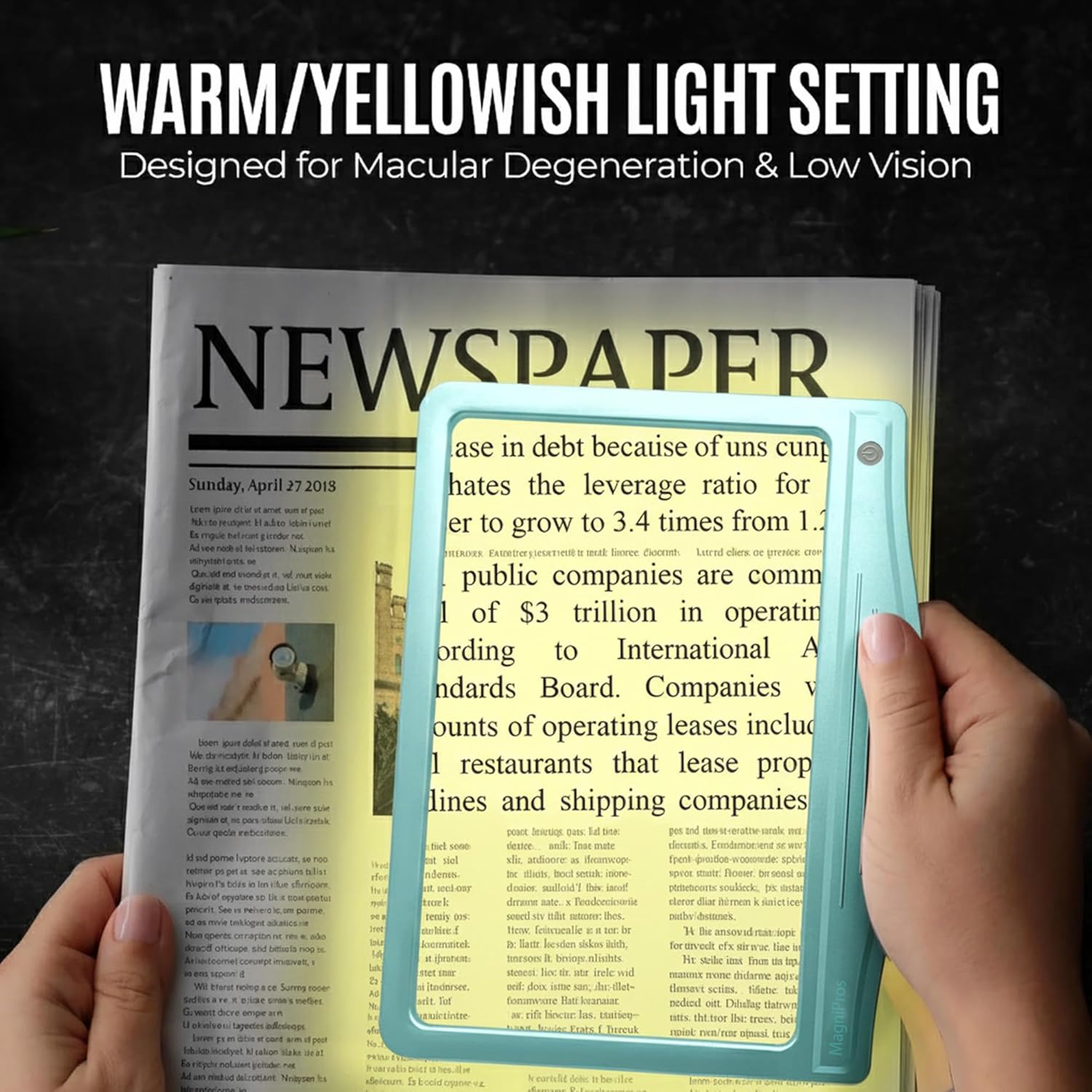
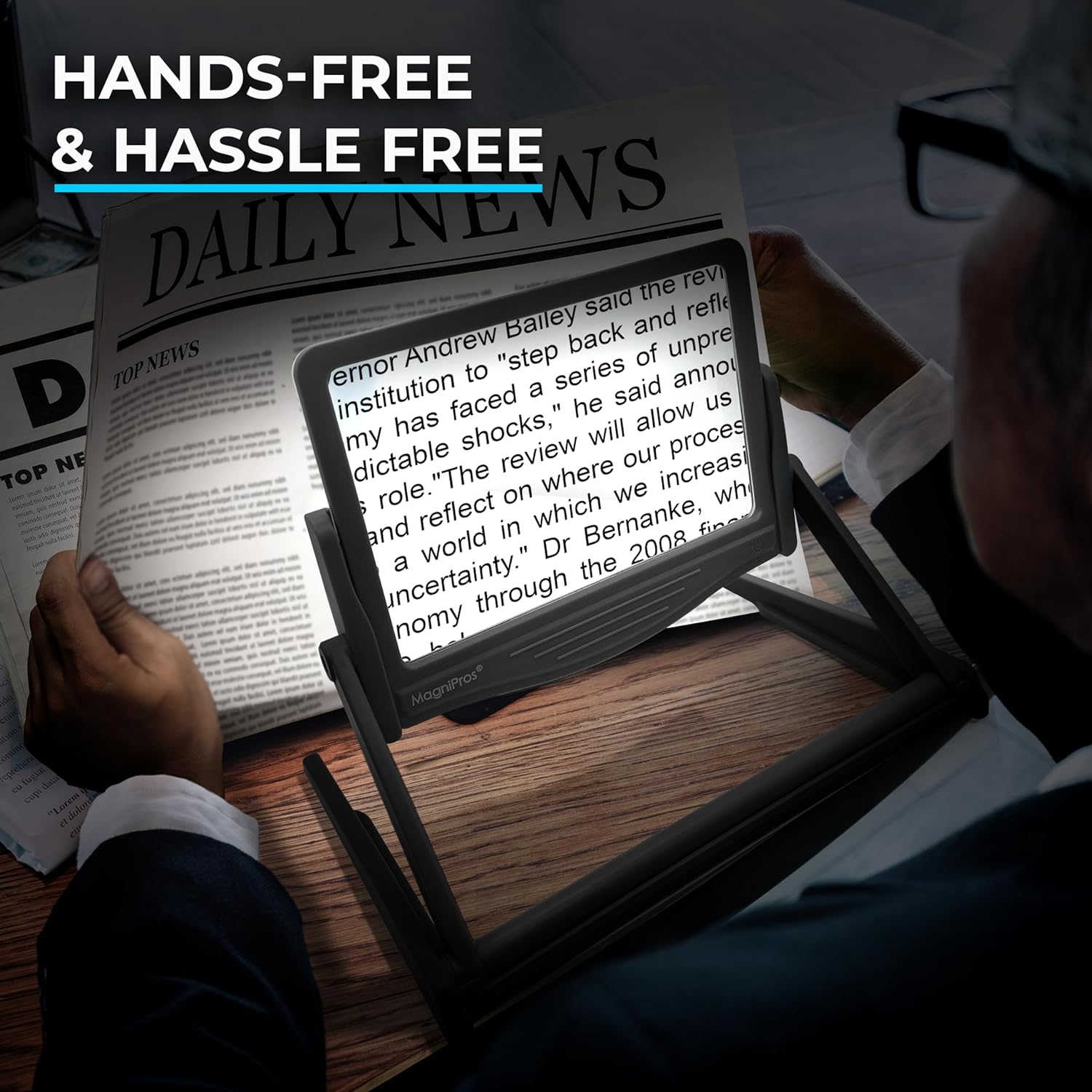
Check price on AmazonThe page-stand form factor has found an enthusiastic audience among people who want to read in conditions — a dim bedroom, a recliner, a hospital bed — where holding a book and a magnifier simultaneously isn’t practical. Two current page-stand configurations are worth distinguishing: a detachable-stand version and a rechargeable cordless version.
The detachable-stand model is designed to be repositioned — the stand separates, allowing the magnifier portion to be used handheld or set on a surface independently. The rechargeable model prioritizes cordless flexibility, which matters for anyone moving between rooms or who lacks a convenient outlet near their reading spot. Both share the same optical approach: a large-surface lens mounted in a frame that angles over a page, with an integrated LED light strip.
Across aggregated reviews, the pattern for both models is consistent: owners report that the ability to read without holding anything is the primary reason they are satisfied with the purchase. The reviewer who bought one after magnifying glasses failed her at night — that story recurs, in different words, across dozens of verified purchase comments.
The real limitation to name: Reviewers note that both page-stand units can wobble noticeably when placed on thick hardcover books, because the base assumes a relatively flat, stable surface. LED light quality draws mixed feedback — adequate for dim rooms in most accounts, but not bright enough for users with significant contrast sensitivity loss. Occasional shipping quality issues (misaligned light fixtures, minor cosmetic defects) appear in the review corpus often enough to note as a buying consideration rather than an isolated complaint.
Decision frame: If your client or family member needs to read in bed or a recliner without holding a device, and the lighting environment is moderately dim rather than fully dark, a page-stand magnifier is a rational first hands-free purchase. For the rechargeable version, choose it when outlet access is limited or the user moves between rooms. Choose the detachable-stand version when occasional handheld use is also desired. If significant contrast sensitivity loss is part of the picture, the LED output may be insufficient, and the floor lamp form factor is worth evaluating instead.
VisionAid
$18.99
In stock on Amazon
Check price on AmazonFloor Lamp Magnifiers: Stability Questions and Long-Use Reality
MagniPros
$21.80
In stock on Amazon
Check price on AmazonThe floor lamp magnifier positions a large lens on a flexible or jointed arm extending from a weighted floor base. The design is modeled on the craft-lamp magnifier style that has been a staple in sewing rooms and low-vision settings for decades. ABLEDATA’s Magnifiers and Low Vision Aids Product Database (abledata.acl.gov) notes that floor lamp magnifiers are among the most recommended form factors for sustained task work — sewing, crafts, document review — because they require no surface area, position the lens at a natural working height, and integrate illumination in a single unit.
Long-run reviewer feedback on floor lamp magnifiers generally confirms these advantages. Owners report using them daily for needlework, crossword puzzles, and similar tasks without the grip fatigue associated with handheld lenses. The integrated LED in quality floor lamp models is typically brighter than the strip lighting in page-stand units, which makes a meaningful difference for users with contrast sensitivity loss.
The stability concern: Base wobble is the most cited negative across long-run reviews of floor lamp magnifiers. Reviewers who place them on carpet or uneven flooring report that the base feels less secure than expected. However — and this is important for practitioners advising seniors living alone — the pattern in extended-use reviews is that the base holds in place during actual use; it is during assembly and repositioning that instability is most noticeable. Several reviewers explicitly note they completed assembly without assistance and found the unit stable once positioned. That doesn’t make the concern irrelevant, but it does suggest the risk is highest during setup, not during daily reading.
Assembly and solo-senior usability: For a senior living alone, the assembly step is the genuine friction point. The floor lamp requires attaching the arm and positioning the base, which involves some lifting and leverage. Reviewers who completed it solo generally describe it as manageable in 15–20 minutes. The American Occupational Therapy Association’s guidance on home equipment introduction for low-vision clients (AOTA.org) supports caregiver-assisted first-time setup as standard practice for users with significant strength or balance limitations — a reasonable precaution here as well.
MagniPros
$21.80
In stock on Amazon
Check price on AmazonHeadset Magnifiers: The Wearable Trade-Off
MAGNIPROS
$24.95
In stock on Amazon
Check price on AmazonThe headset magnifier occupies a different use-case lane than the floor lamp or page stand. It is designed to be worn — positioned like lightweight eyewear or a visor — so the lens moves with the wearer’s head and both hands remain completely free. Jewelers, model-builders, and anyone doing fine-motor close work have used this style for years; the format is increasingly available to a broader low-vision and accessibility audience at accessible price points.
What reviewers consistently report: Headset magnifiers in this category are notably lighter than users expect, which matters significantly for extended wear. Prescription glasses compatibility is a frequently praised feature — multiple reviewers confirm a comfortable fit over existing glasses or bifocals, which is not always the case with headset magnifiers in this price range.
The LED limitation: The integrated LEDs on headset magnifiers are modest. In well-lit environments, reviewers don’t flag this as a problem. In dim conditions — exactly the scenario where floor lamps and page stands have a natural advantage — the headset’s LEDs may not provide sufficient illumination for users with moderate-to-severe low vision. This is the core tradeoff: portability and prescription-glasses compatibility come at the cost of illumination power.
Wear duration: Across extended-use reviews, owners generally report headset magnifiers comfortable for 45–60-minute sessions. For tasks over an hour, reviewer feedback becomes more mixed — some find continued wear fine, others note mild neck or forehead fatigue. No wearable magnifier is as fatigue-free as a hands-free stationary solution over long sessions. The Royal National Institute of Blind People’s guide “Choosing a Magnifier” (RNIB.org.uk) explicitly recommends trialing wearable magnifiers for realistic task durations before committing, precisely because comfort over time varies significantly between users.
MAGNIPROS
$24.95
In stock on Amazon
Check price on AmazonThe Decision Rules
If you are an OT conducting a home equipment evaluation, a caregiver researching for a family member, or a buyer choosing for yourself, here is the simplified framework:
-
If the task is reading in bed or a recliner, in a moderately dim room, with mild-to-moderate low vision: a page-stand magnifier is the most direct fit. Choose the rechargeable version if outlet access is limited or the user moves between rooms; choose the detachable-stand version if occasional handheld use is also desired.
-
If the task is sustained craft or hobby work (needlework, crossword puzzles, document review) in a chair, and lighting is a meaningful need: a floor lamp magnifier is the stronger call. Arrange for assisted assembly if the user has significant strength or balance limitations.
-
If the task is fine close-up work (jewelry, model assembly, detailed hobby tasks) in a well-lit space, and portability or prescription-glasses compatibility matters: a headset magnifier is the appropriate form factor. Set expectations on LED brightness and recommend supplemental room lighting for dim environments.
-
If significant contrast sensitivity loss is part of the functional picture: reassess LED brightness across all three options, and consider whether a higher-lux clinical-grade magnifier or a dedicated video magnifier (CCTV-style electronic magnifier) better serves the need. Both ABLEDATA (abledata.acl.gov) and the American Foundation for the Blind (AFB.org) maintain searchable databases of electronic magnifiers that support comparison at that level.
Frequently Asked Questions
Can these magnifiers be used while wearing prescription glasses or bifocals? Headset magnifiers in this category are explicitly designed and reviewed favorably for use over prescription glasses — multiple owners confirm a comfortable fit. Page-stand and floor lamp magnifiers don’t touch the face at all, so prescription glasses are irrelevant to their use; you simply look through the lens as you would any freestanding optical aid.
How do I stop the page stand from wobbling on a large hardcover book? The wobble occurs because the stand’s feet assume a flat surface. Placing a thin, firm mat or a clipboard under the book creates a stable, level base that eliminates most of the movement reviewers describe. A non-slip shelf liner works as well and costs very little.
What is the difference between the detachable-stand and rechargeable page-stand models? The detachable-stand version separates into a handheld lens and a stand, giving dual-use flexibility. The rechargeable version is a single integrated unit powered by a built-in battery, prioritizing cordless convenience over reconfigurability. Both use similar optics; the choice comes down to whether the user wants portability between rooms (rechargeable) or occasional handheld use (detachable).
Is the floor lamp magnifier sturdy enough for a senior living alone to assemble safely? Based on aggregated long-run reviews, the unit is stable once assembled — daily-use reviewers do not report tipping during normal use. The assembly step is where the risk is highest for users with limited strength or balance. Assisted first-time assembly is a reasonable precaution, consistent with the American Occupational Therapy Association’s guidance on home equipment introduction for low-vision clients (AOTA.org).
Can the headset magnifier be worn for an hour or more without head fatigue? Reviewer consensus suggests 45–60 minutes is comfortable for most users. Sessions beyond that produce more variable feedback. The low weight is a genuine advantage in this category, but no wearable magnifier is as fatigue-free as a stationary hands-free solution over long sessions.
Does the LED light on page-stand magnifiers work well enough to read in a dark room? For users with mild-to-moderate low vision in a dim — not fully dark — room, reviewers generally find the LED adequate. For users with significant contrast sensitivity loss, or those reading in a very dark environment, the LED output is more frequently flagged as insufficient. Supplemental bedside lighting alongside the page stand addresses this in many cases.
Sources cited in plain text: American Foundation for the Blind — Low Vision Devices Overview, AFB.org; American Occupational Therapy Association — Low Vision and Occupational Therapy, AOTA.org; ABLEDATA, Administration for Community Living — Magnifiers and Low Vision Aids Product Database, abledata.acl.gov; Royal National Institute of Blind People — Choosing a Magnifier, RNIB.org.uk.