Imagine you’ve just received a referral for a client with macular degeneration — the part of the eye responsible for sharp central vision has deteriorated, making reading print feel like trying to read through a smudged windshield. They want to read mail, medication labels, and the occasional paperback. They don’t need a $3,000 electronic video magnifier (also called a CCTV, a desktop device that displays a magnified image on a screen). They need something that costs under $200, works without a power outlet, and fits in a jacket pocket. Where do you start?
LED page magnifiers — optical lenses with built-in LED lighting — are the first serious tool in that price range worth recommending. They’re not glamorous, they don’t run on software, and they rarely appear in funding discussions. But get this decision right and you’ve solved a real daily-living problem quickly and cheaply. Get it wrong and you’ve set up a frustrated client who abandons the device in a drawer and loses confidence in the whole assistive technology pathway. This guide breaks down the three major form factors — handheld, hands-free stand, and wearable — names the tradeoffs explicitly, and tells you when to move up the price ladder instead.
| EDITOR'S PICK[MAGNIPROS Patented 5X Large LED…](https://www.amazon.com/dp/B0DDRYZTY5?tag=greenflower20-20) | Mid-tierMagnifying Glass with Light | Budget pick[JMH Magnifying Glass with Light](https://www.amazon.com/dp/B08XXF1VCS?tag=greenflower20-20) | |
|---|---|---|---|
| Magnification | 5X | 1.5X-5.0X | — |
| Style | Page | Headset | Handheld |
| LED modes | 3 | — | 3 |
| Rechargeable | — | ✓ | — |
| Stand included | ✓ | — | — |
| Price | $24.95 | $19.99 | $9.99 |
| See on Amazon → | See on Amazon → | See on Amazon → |
Why Form Factor Matters More Than Magnification Power
This is the most common error in low-vision device matching: focusing on the magnification number (“5x! 10x!”) before settling the form-factor question. Magnification power and form factor are co-dependent decisions.
The physics reality: Higher optical magnification means a shorter working distance — how close the lens must be to the page to stay in focus. A 10x handheld loupe has a working distance of roughly 2.5 cm. That’s close enough to cast a shadow with your hand, which is why LED illumination exists — but it also means sustained reading at that power becomes physically tiring within minutes. The Royal National Institute of Blind People, in their consumer guide “Magnifiers Explained,” states that most sustained reading tasks are best served at 4x–8x optical magnification, and that powers beyond that range are better suited for spot-reading tasks (price tags, pill bottles) rather than continuous text.
Form factor, meanwhile, determines posture, fatigue, and context. The three major types break down like this:
| Form Factor | Typical Price Range | Best Use Case | Key Limitation |
|---|---|---|---|
| Handheld LED | $15–$80 | Spot reading, travel, versatility | Arm fatigue over sustained reading |
| Stand / hands-free | $25–$150 | Sustained reading, writing, tremor users | Less portable, fixed working distance |
| Wearable (head-mounted optical) | $80–$400+ | Hands-free near and mid-range | Fit/comfort variability, social acceptance |
The American Foundation for the Blind, in their resource guide “Understanding Low Vision Devices,” draws a clear line between optical magnifiers (lens-based, no power required for the magnification itself) and electronic magnifiers (camera-to-screen, requiring power). This article covers optical LED devices in the first two tiers. Wearable electronic magnifiers — such as head-mounted camera-and-screen systems — are a separate category with separate funding considerations and a separate price tier ($2,500–$6,000+).
Handheld LED Magnifiers: The Workhorse Tier
Who it fits: Clients with mild-to-moderate low vision, good hand stability, and varied reading contexts — moving between rooms, reading in waiting rooms, checking labels at a grocery store.
Who it doesn’t fit: Anyone with essential tremor, significant grip weakness, or upper-limb fatigue. A shaking hand at 6x magnification makes text unreadable. This is the disqualifying factor that often gets overlooked in a quick recommendation.
The handheld market runs from disposable-quality plastic lenses with a single LED to well-built glass optics with multi-LED rings. The distinction matters. ABLEDATA, the assistive technology product database maintained by the Administration for Community Living, consistently distinguishes in its optical magnifier entries between acrylic lenses (lighter, cheaper, more optical distortion at the edges) and glass lenses (heavier, clearer field of view, noticeably better color rendering under LED light).
Budget Handheld: Wide Field, Moderate Power
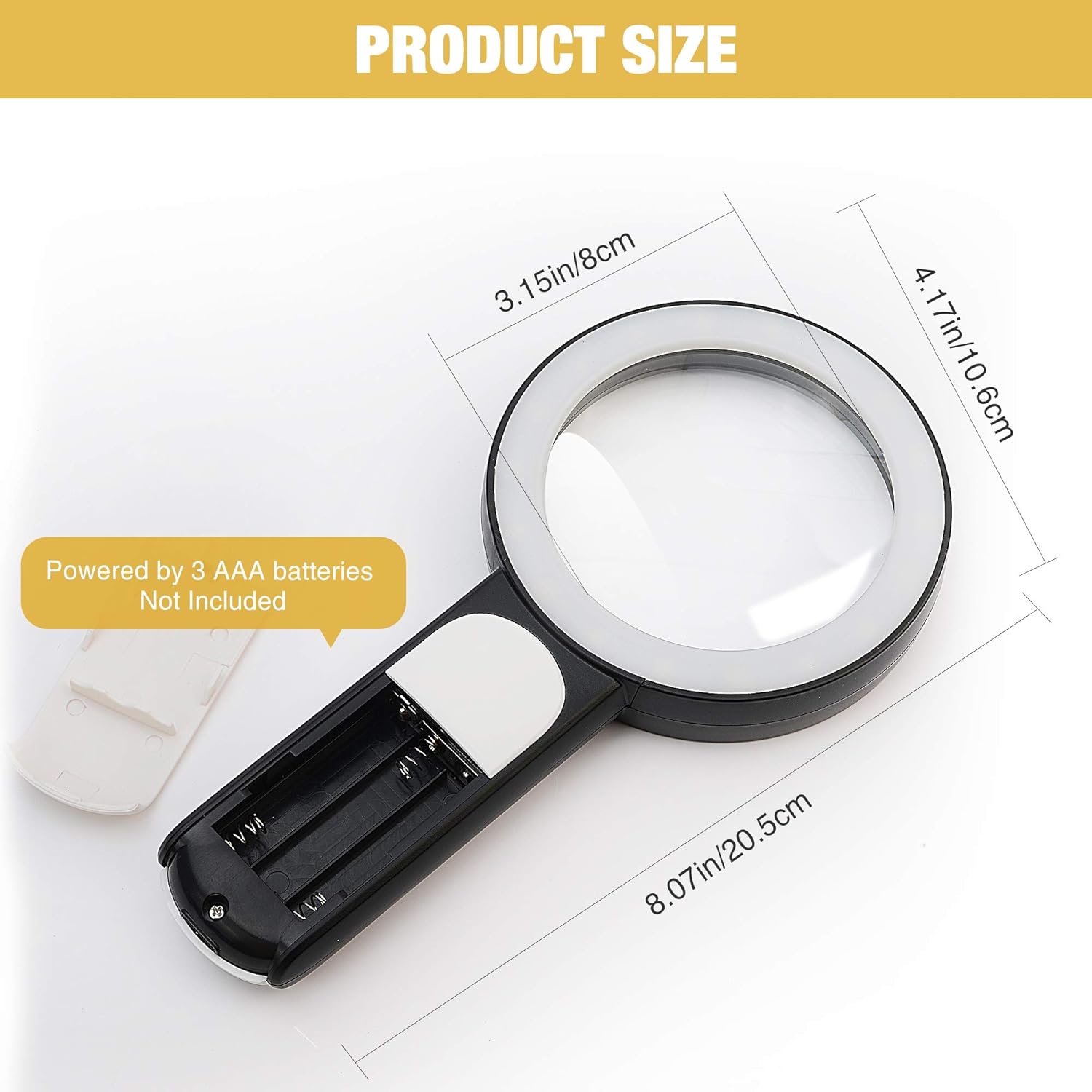
For buyers prioritizing portability and everyday spot reading at the lowest reliable entry point, a glass-optic LED handheld in the 3x–4x range with a lens diameter of 75mm or larger delivers a wide reading field without arm-fatiguing close working distances. Lens diameter matters as much as power here: a 3x lens at 90mm gives a much wider reading window than a 6x lens at 55mm, and for macular degeneration users whose peripheral vision is relatively preserved, that wider field often reads more comfortably. Reliable options in this tier run $25–$45 from rehabilitation-positioned manufacturers such as Eschenbach and Coil.
JMH
$9.99
In stock on Amazon
Check price on AmazonMid-Tier Handheld: Glass Optics and LED Color Control
In the $45–$75 range, handheld LED magnifiers begin to offer features that matter clinically. LED color temperature is the most important: cool white LEDs (5000K–6500K) maximize contrast on black ink on white paper, while warm LEDs (2700K–3000K) reduce glare for users with photosensitivity. Some mid-range handhelds include a toggle between modes; most budget units do not. Battery type is the second variable: replaceable AAA batteries are the right call for older adults or anyone in a care setting. The Royal National Institute of Blind People’s “Magnifiers Explained” consumer guide specifically notes rechargeable-only devices as a compliance barrier in older adult populations, since a required charging routine becomes a daily obstacle that some users avoid. The American Occupational Therapy Association’s “Low Vision Rehabilitation” practice guidelines reference optically rated magnifiers from rehabilitation-focused manufacturers as preferred over unrated consumer-grade alternatives — a distinction that becomes meaningful in the mid-tier, where the price gap between rated and unrated narrows.
Magnifying
$19.99
In stock on Amazon
Check price on AmazonPremium Handheld: Large-Diameter, High-Grade Optics
At $75–$120, handheld optical magnifiers offer large-diameter lenses (95mm–120mm), premium glass with reduced chromatic aberration, and in some cases multi-LED configurations that eliminate shadowing. These are genuinely useful for users who need a wide reading window at moderate magnification (3x–5x) — think reading a broadsheet newspaper or a large-format book. Beyond $120 in handheld optical, you’re approaching entry-tier portable electronic magnifiers, and the funding conversation changes.
MAGNIPROS
$24.95
In stock on Amazon
Check price on AmazonHands-Free Stand Magnifiers: The Sustained-Reading Answer
Who it fits: Anyone who needs to read for more than 10–15 minutes at a stretch, users with tremor or grip limitations, writers who need to see source material while their hands are free, and children doing homework who need both hands available.
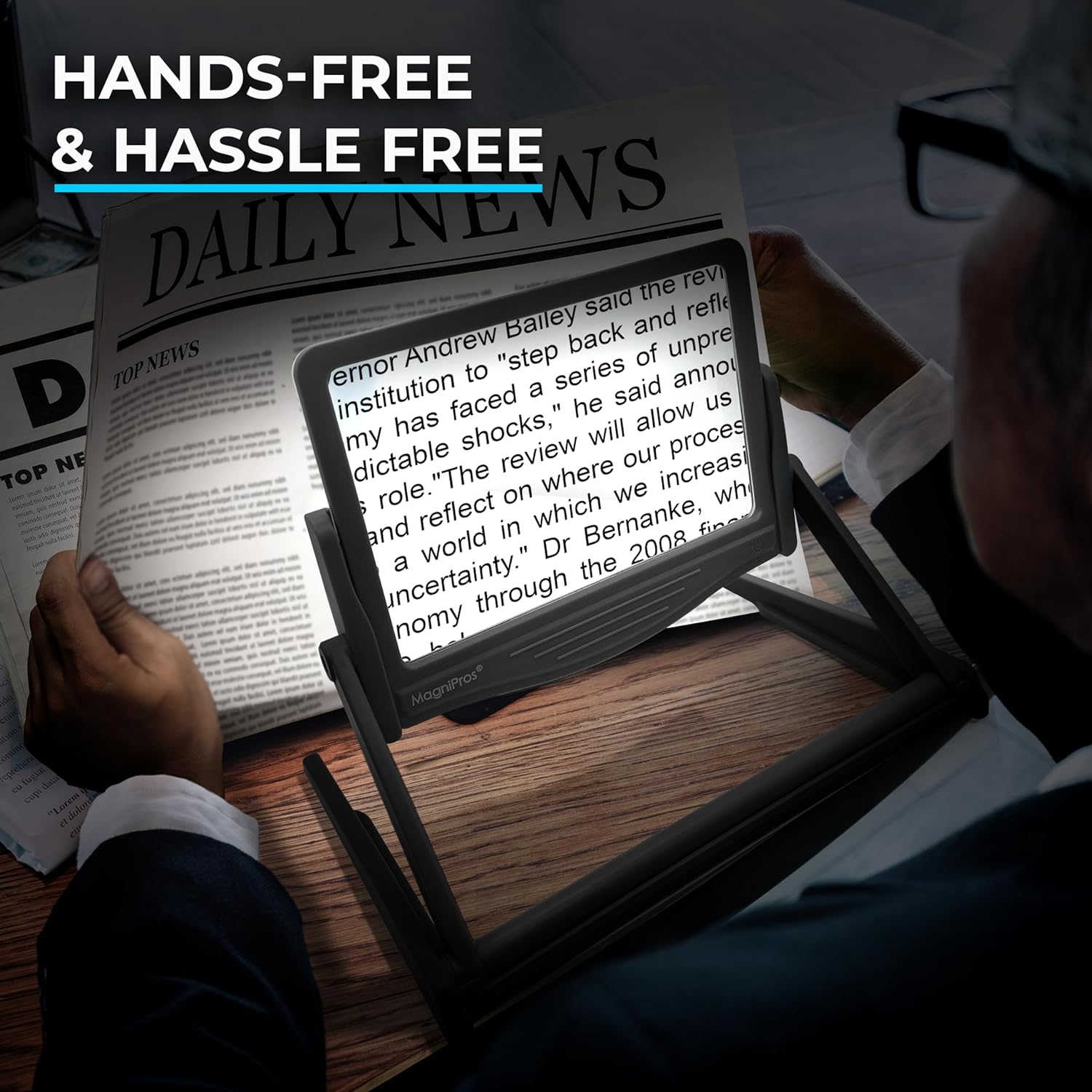
Stand magnifiers rest directly on the page, maintaining a fixed working distance automatically. That fixed distance is the key advantage: the optics are pre-focused, and the user doesn’t have to hold anything steady. The LED ring built into the stand illuminates the text beneath.
Budget Stand: Domed LED Over Flat Fresnel
Budget “page magnifiers” sold as flat Fresnel lens sheets (typically $5–$20) provide mild magnification (1.5x–2x) with no lighting and significant edge distortion. These are convenience tools, not low vision rehabilitation tools. A proper domed stand magnifier with integrated LED — typically starting around $25–$45 — uses a curved lens ground to a specific diopter rating, provides consistent magnification across most of the field, and includes illumination. The Lighthouse Guild, in their clinical resource “Choosing a Magnifier for Low Vision,” notes that diopter-rated stand magnifiers are more reliably prescribed than non-rated consumer alternatives because practitioners can document the optical correction in the intervention record.
JMH
$9.99
In stock on Amazon
Check price on AmazonMid-Tier Stand: Sustained Reading at 4x–6x
Stand magnifiers at 4x–6x are genuinely usable for reading novels, magazines, and standard-print documents for 30–60 minutes. At 8x and above, the reading window narrows enough that sustained reading becomes tiring due to the number of tracking movements required per line. The RNIB’s “Magnifiers Explained” guide recommends trialing higher-power stand magnifiers before recommending them as a primary reading tool. Mid-tier stand magnifiers in the $50–$100 range from Eschenbach and Coil represent the practical center of gravity for occupational therapy recommendations — wide enough field, appropriate power, and durable enough for daily use.
Magnifying
$19.99
In stock on Amazon
Check price on AmazonPremium Stand: Approaching the Electronic Threshold
The practical ceiling for a well-lit, optically capable stand magnifier is roughly $120–$150 (Eschenbach Mobilux and comparable Coil stand series models are frequently cited in this tier by low vision practitioners). Beyond that price point, buyers are approaching the entry tier of portable electronic magnifiers — handheld camera-and-screen devices offering variable magnification, freeze-frame, and contrast mode inversion. That’s a meaningful capability jump, and the American Foundation for the Blind’s “Understanding Low Vision Devices” guide is explicit that very high optical magnification (10x+) is generally outpaced by low-power electronic magnification for sustained reading tasks, because electronic devices offer contrast manipulation and variable magnification that optical lenses cannot.
MAGNIPROS
$24.95
In stock on Amazon
Check price on AmazonWearable Optical Magnifiers: The Hands-Free Middle Ground
Who it fits: Users who need sustained near-vision magnification without holding anything, but who are not ready for — or cannot fund — a $2,500+ electronic wearable. Hobbyists doing fine work (needlework, model-building, watch repair) who also have low vision, and professionals in hands-on roles.
Budget Wearable: Clip-On and Basic Head-Mounted Loupes
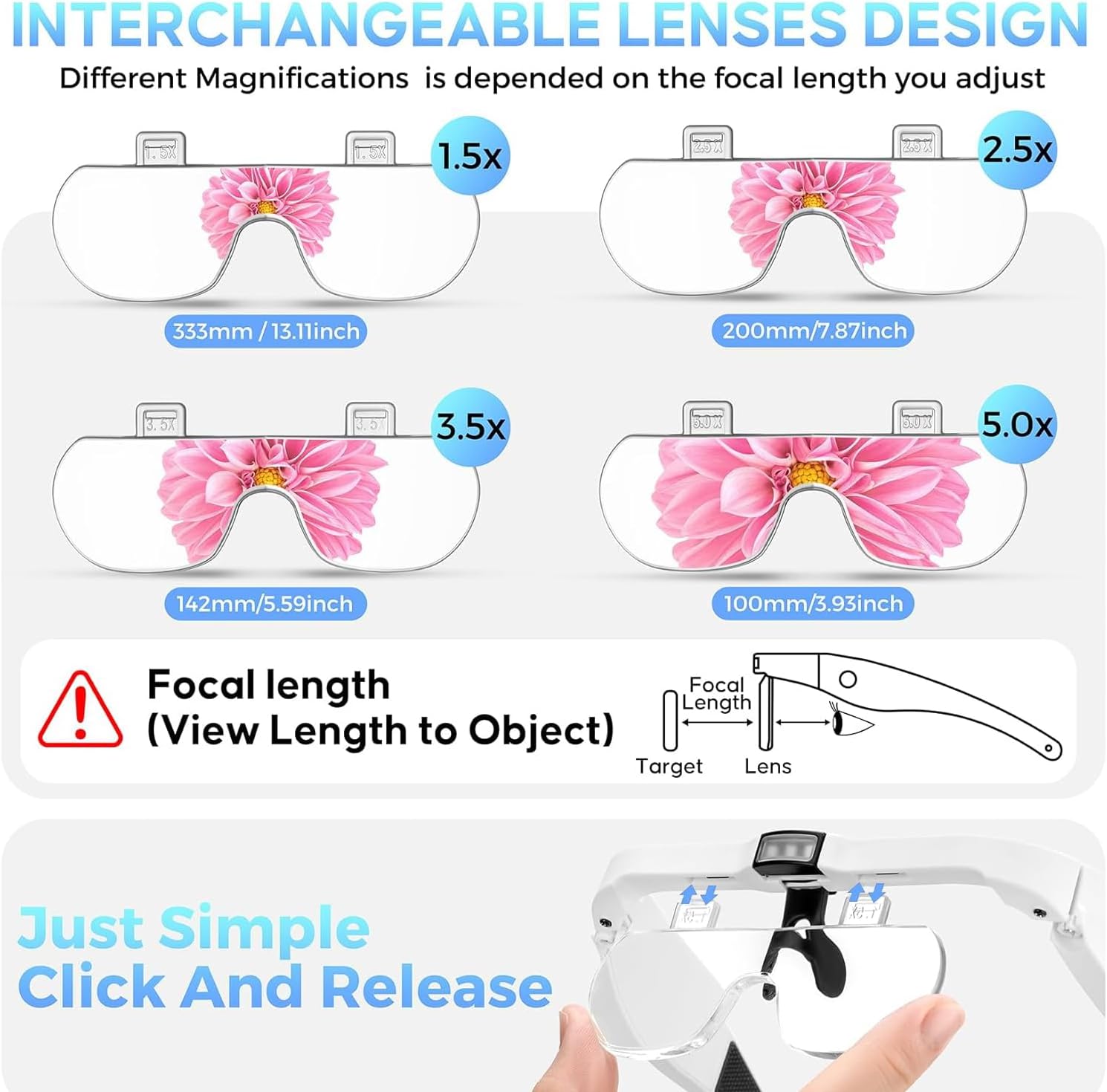
Entry-level wearable optical magnifiers ($80–$140) include clip-on prismatic designs and basic head-mounted loupes. These offer hands-free near magnification but require the user to position their head correctly to stay in the focal zone. For users whose low vision includes nystagmus (involuntary eye movement) or scanning difficulties, this positional requirement can make the device effectively unusable without training from a low vision therapist.
JMH
$9.99
In stock on Amazon
Check price on AmazonMid-Tier Wearable: Rehabilitation-Positioned Head-Mounted Optics
In the $150–$280 range, brands appearing frequently in low vision rehabilitation contexts — including Eschenbach’s MaxDetail line — offer improved field of view and lighter frame weights that improve wearing tolerance over longer sessions. ABLEDATA’s optical magnifier database includes entries in this tier with clinical prescription notes, indicating they are typically recommended in consultation with a low vision optometrist rather than selected independently.
Magnifying
$19.99
In stock on Amazon
Check price on AmazonPremium Wearable: Bioptic-Style Optical Frames
At $300–$400, bioptic-style optical frames mount a small telescope above the primary lens line and appear in ABLEDATA’s database with practitioner-documented prescription records. These are not self-selected devices — they are fitted and prescribed by low vision optometrists. For reference, the next tier above this is wearable electronic magnification (eSight, NuEyes, and comparable systems at $2,500–$6,000), which requires a separate funding strategy: Medicaid Home and Community-Based Services waivers in applicable states, vocational rehabilitation funding through state VR agencies, and manufacturer financing programs.
MAGNIPROS
$24.95
In stock on Amazon
Check price on AmazonBy the Numbers
- $25–$80: Practical budget for a diopter-rated, LED-illuminated handheld or stand optical magnifier from a rehabilitation-positioned manufacturer
- 4x–8x: Optical magnification range best suited for sustained reading; spot-reading tasks can go higher without undue fatigue
- ~2.5 cm: Working distance at 10x magnification — close enough for hand shadow to be a real problem, and too close for comfortable sustained reading posture
- $150: Approximate ceiling where optical LED magnifiers stop competing with entry-tier portable electronic magnifiers on functional capability
The Decision Rule: If X, Then Y
If the client has good hand stability and variable reading environments (home, clinic, community), start with a glass-optic LED handheld in the 4x–6x range, $40–$70, from Eschenbach or Coil. Trial before committing to power level.
If the client has tremor, grip weakness, or needs 30+ minutes of sustained reading, go directly to a domed LED stand magnifier, 4x–6x, $40–$100. Skip the handheld recommendation entirely — you’re setting up a dropout.
If the client’s functional vision loss is moderate-to-severe and optical magnifiers are providing marginal benefit at 8x, the clinical next step is a portable electronic magnifier ($300–$700 range) or a desktop CCTV — not a higher-powered optical loupe. The American Foundation for the Blind’s “Understanding Low Vision Devices” guide is explicit that very high optical magnification is generally outpaced by low-power electronic magnification for sustained reading because electronic devices offer contrast manipulation that optics cannot replicate.
If budget is the constraint for an electronic device, document the functional limitation and initiate a vocational rehabilitation referral, or explore state assistive technology lending library programs — available in most states through the AT3 Center network — for a trial period before the client commits to a purchase. The American Occupational Therapy Association’s “Low Vision Rehabilitation” practice guidelines emphasize that anchoring a client to an optical device that functionally undershoots their needs — solely because the price is accessible — produces abandonment outcomes that are measured in lost independence, not just wasted dollars.
LED optical magnifiers are the right first tool for a meaningful portion of low vision users. Know when they’re sufficient, know when they’re not, and you’ll close the right recommendation the first time.