Imagine your client has age-related macular degeneration — a condition where the central part of vision gradually blurs, making reading small print feel like trying to read through frosted glass. Her OT has recommended an optical magnifier (a lens device that makes text physically larger, without a screen or software), but she’s overwhelmed: the market runs from a $12 pocket lens to a $300 illuminated floor lamp on a swing arm. She asks you: “Does it matter which style I get?” The answer is yes — and this article explains exactly why the form factor (the physical shape and how you hold or position the device) matters far more than raw magnification power when it comes to daily usability, fatigue, and long-term compliance. By the end, you’ll have a clear decision framework you can apply to your current cases.
| EDITOR'S PICK[MAGNIPROS Patented 5X Large LED…](https://www.amazon.com/dp/B07S5RZJDR?tag=greenflower20-20) | Mid-tier[MagniPros 5X Rechargeable Large…](https://www.amazon.com/dp/B07S5RZJDR?tag=greenflower20-20) | Budget pick[JMH Magnifying Glass with Light](https://www.amazon.com/dp/B08XXF1VCS?tag=greenflower20-20) | |
|---|---|---|---|
| Magnification | 5X | 5X | — |
| Anti-glare | ✓ | ✓ | — |
| Rechargeable | — | ✓ | — |
| Stand | ✓ | — | — |
| LED type | — | — | Cold + warm |
| Price | $24.95 | $21.80 | $9.99 |
| See on Amazon → | See on Amazon → | See on Amazon → |
Why Form Factor Outweighs Power — The Core Insight
The low-vision magnifier market has a persistent misconception baked in: that “more magnification equals more helpful.” In practice, the American Foundation for the Blind’s guidance on optical aids, available at afb.org, makes clear that beyond a clinically indicated magnification level, the more important variables are working distance (how far the lens sits from the page), field of view (how much text you can see at once), and — critically — how much physical effort the user must sustain to keep the device stable and positioned.
The Royal National Institute of Blind People’s resource “Choosing a Magnifier,” available at rnib.org.uk, frames it directly: fatigue and hand function should be assessed before optical power when prescribing or recommending a device. This is the practitioner’s core tension. A 5x handheld lens may be clinically sufficient for a user with moderate vision loss, but if that user has rheumatoid arthritis or a progressive motor condition, holding anything steadily for 20 minutes of reading is functionally impossible — making the “correct” magnification level irrelevant.
ABLEDATA’s magnifier and low-vision optical devices product category listings, hosted at abledata.acl.gov, identify three durable optical form factors for non-electronic magnification: handheld, page (also called full-page or stand magnifiers placed flat on the reading material), and floor lamp (an illuminated lens mounted on an adjustable arm or stand that positions itself over the work surface). Each has a clearly distinct ergonomic profile — and a distinct user who actually benefits.
By the numbers:
- Handheld magnifiers: typical magnification range 2x–10x; requires sustained grip and arm position
- Page/stand magnifiers: typical range 1.5x–3x; hands-free once placed; field of view often 8”–10” across
- Floor lamp magnifiers: typical range 1.75x–5x with integrated LED ring; frees both hands; arm reach 30”–50” adjustable
Comparing the Three Form Factors: Ergonomics, Use Cases, and User Fit
The sections below evaluate each form factor as a distinct tier of recommendation — from the most portable and lowest-barrier entry point through the most hands-free and posture-flexible option. Each section closes with a tier marker to orient purchasing decisions.
Handheld Magnifiers: Maximum Flexibility, Real Fatigue Cost
Handheld magnifiers are the default recommendation in many settings because they’re portable, intuitive, and inexpensive. For the right user — someone with intact hand strength, no tremor, and short intermittent reading tasks like checking a price tag or a medicine label — they remain the most practical choice.
Where this form factor breaks down is sustained reading. The core physical demand is threefold: the user must maintain grip on the handle, hold the lens at a consistent focal distance from the page, and track the lens across lines of text — all simultaneously and without rest. For users managing joint pain, reduced grip strength, or tremor, this combination becomes fatiguing within minutes. Aggregated owner feedback on illuminated handheld magnifiers consistently surfaces this concern: users with rheumatoid arthritis or essential tremor report wanting a stand or support option rather than a different magnification level, which signals that the optical prescription is correct but the form factor is wrong.
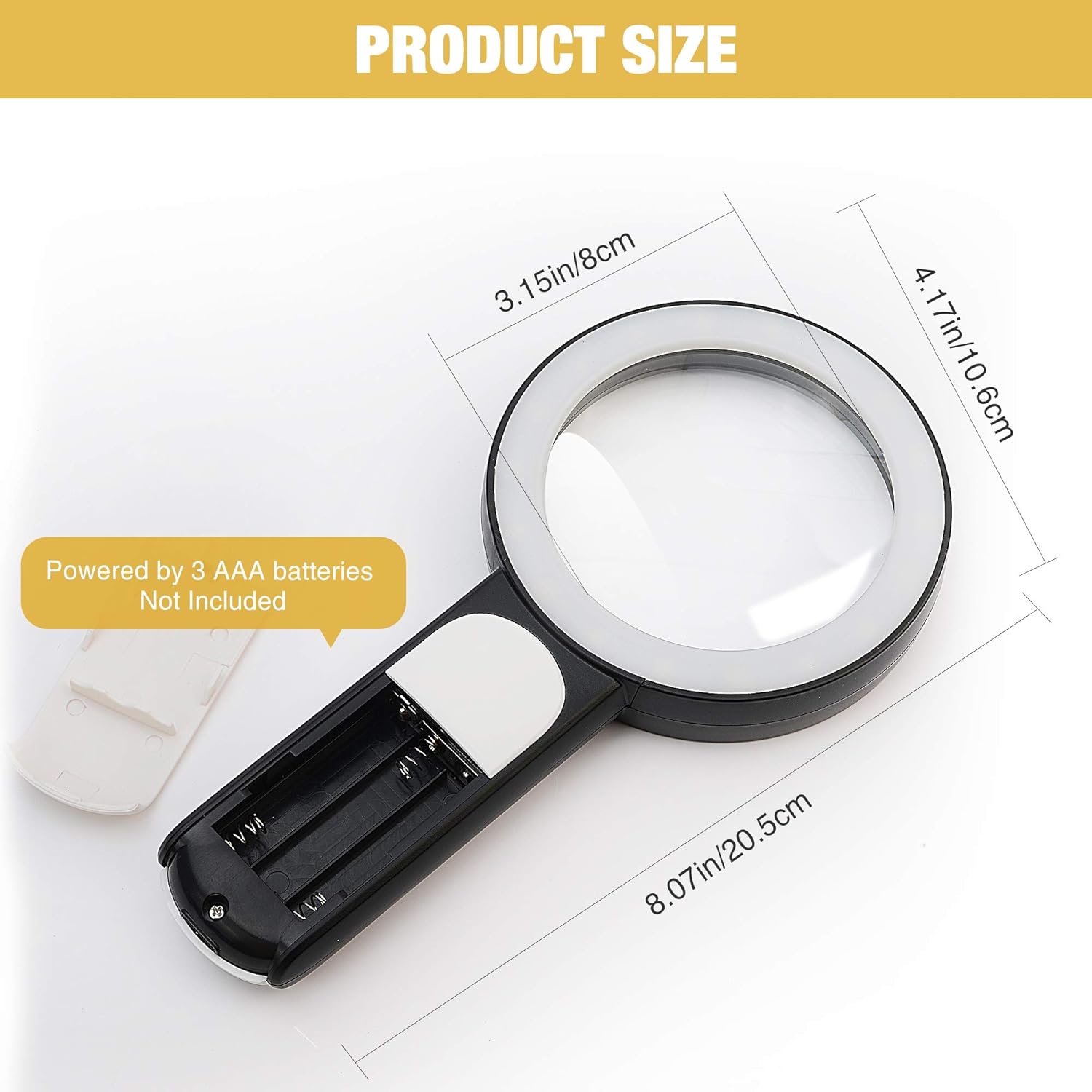
One design variable that meaningfully improves handheld function is circumferential (ring) lighting. Side-lit handheld designs — where an LED sits on one side of the lens frame — cast a directional shadow across the reading surface depending on hand angle. A ring-light design surrounds the lens with light from all sides, eliminating this problem. This matters most for users who are blind in one eye or who have monocular vision, because they cannot compensate for shadow by shifting viewing angle.
If-then rule for handhelds: If your client has full hand function and reads in short sessions (under 10 minutes) across varied locations — restaurant menus, medication bottles, printed mail — a quality illuminated handheld with ring lighting is the right recommendation. If they report hand fatigue, tremor, or RA, move to the next category.
JMH
$9.99
In stock on Amazon
Check price on AmazonPage Magnifiers: The Hands-Free Middle Ground
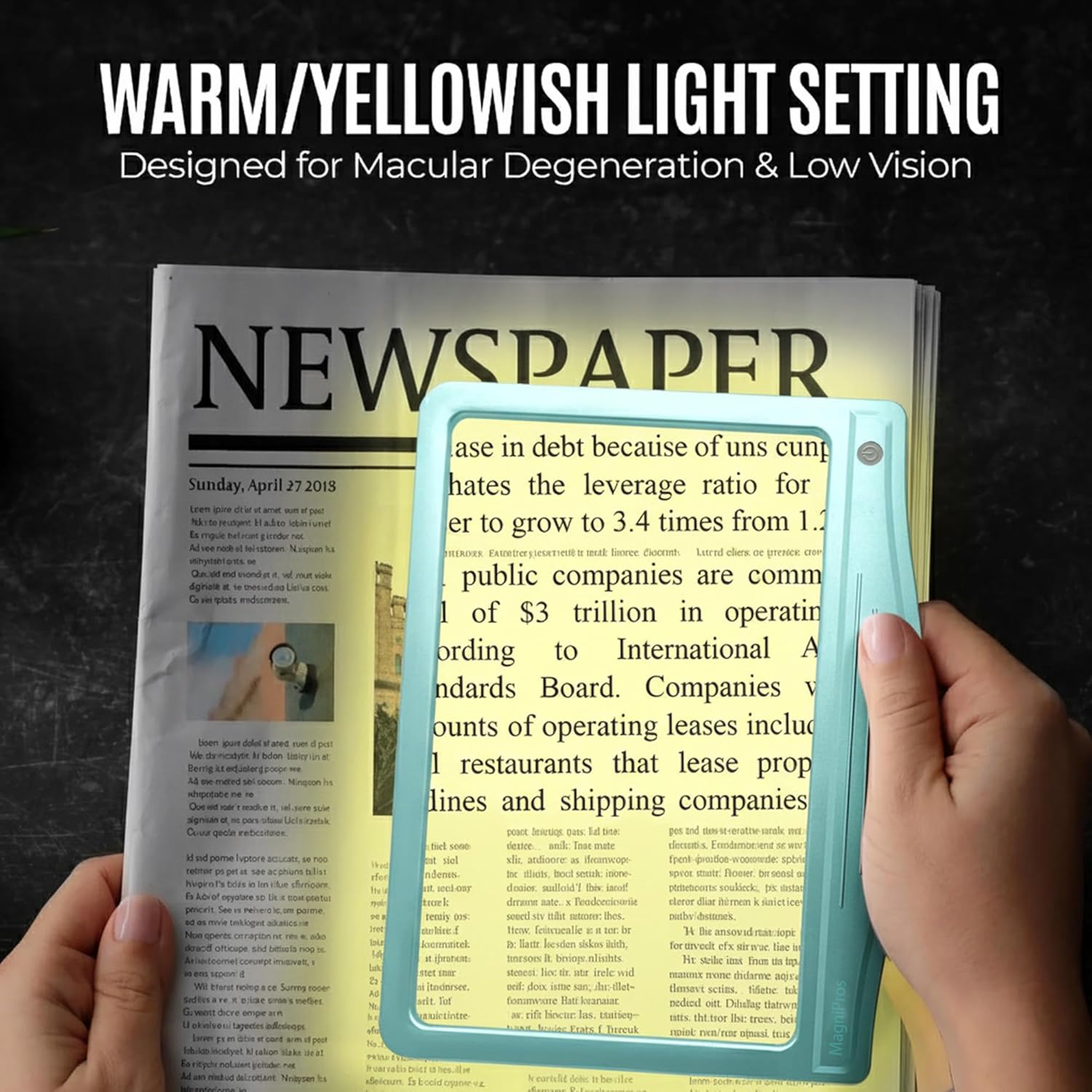
A page magnifier — sometimes called a full-page or Fresnel magnifier — is a flat lens, usually rigid or semi-rigid, that the user places directly on top of the reading material. The lens covers a wide field of view (often the full width of a book page), and because it rests on the page itself, the user doesn’t have to maintain focal distance — the lens does that work. Both hands are free to hold the book, turn pages, or rest.
A Fresnel lens (named after the French physicist Augustin-Jean Fresnel) achieves magnification through a series of concentric grooves etched into a flat plastic surface, rather than through curved glass. The result is a thin, lightweight lens that can span a large area without the weight of traditional ground glass. The trade-off is optical quality: Fresnel lenses typically have slightly more distortion at the edges than high-quality glass, but center-field clarity is sufficient for sustained reading of standard print for most users.
A recurring practical concern from page magnifier owners is wobble on thick books — devotionals, large-print Bibles, hardcovers — where the spine elevation causes the lens to tilt rather than lie flat. This is a real concern for the devotional-reading demographic, which skews older and represents a substantial portion of page magnifier buyers. The American Occupational Therapy Association’s document “Occupational Therapy’s Role in Low Vision Rehabilitation,” available at aota.org, specifically identifies reading position and postural support as an OT domain in visual aid prescription. A page magnifier used on a book positioned on a reading stand or lap desk resolves the wobble issue while also improving cervical posture — worth noting in your documentation.
Page magnifiers are also the correct form factor for users who read in bed or while lying down. The lens rests on the material; the user’s head and body position are irrelevant to lens function. Handheld designs require sustained arm elevation, which is difficult or impossible when lying horizontally.
If-then rule for page magnifiers: If your client reads for extended sessions (books, newspapers, devotionals), has limited hand strength or dexterity, or reads in non-upright positions, a full-page stand magnifier is the recommendation. Address the wobble issue for thick-book users with a reading stand or lap desk.
MagniPros
$21.80
In stock on Amazon
Check price on AmazonFloor Lamp Magnifiers: Both Hands Free, Maximum Posture Flexibility
The floor lamp magnifier is the category that consistently earns the most skeptical first impression and the highest long-term satisfaction — a pattern worth naming directly because it affects client compliance. The design is a large-diameter illuminated lens mounted on a swing arm or gooseneck, attached to a weighted floor base. The user positions the arm so the lens hovers over the work surface, freeing both hands entirely.
The common pre-purchase concern is the base: it looks small relative to the arm’s reach, and first-time buyers worry about tipping. In practice, long-run owners consistently report that this concern resolves within the first few weeks of use. The base weight is engineered to counterbalance the arm, and on even flooring — not on carpet edges or floor thresholds — the unit is stable. The one real precaution is to avoid positioning the base on uneven surfaces or at the edge of area rugs.
The ergonomic signal embedded in user experience data is significant for practitioners: many floor lamp magnifier owners report using the device while seated in a recliner. This is a strong indicator that the form factor is serving users who cannot maintain upright seated posture for extended periods — users with fatigue conditions, chronic pain, COPD, post-stroke positioning needs, or older adults whose most comfortable reading position is reclined. No other optical magnifier form factor serves the recliner use case as naturally.
For users with very limited motor control — including those managing ALS progression, severe tremor, or high-level spinal cord injury — the floor lamp magnifier is the only optical form factor that requires zero hand contact during use. Once positioned by a caregiver or by the user at a moment of higher function, it remains stable and the user reads without touching the device. This makes it worth naming specifically in AAC and ALS care contexts where hand function changes rapidly.
If-then rule for floor lamp magnifiers: If your client reads in a recliner, has progressive hand function loss, requires both hands free during reading tasks, or has expressed frustration with having to “hold something the whole time,” the floor lamp magnifier is the right recommendation. Counsel the base concern proactively — it resolves with use.

MAGNIPROS
$24.95
In stock on Amazon
Check price on AmazonFrequently Asked Questions
Can I use a page magnifier while lying in bed or in a recliner? Yes — this is one of the page magnifier’s clearest advantages. Because the lens rests on the reading material rather than being held in the air, your head and body position don’t affect how the lens works. Lying flat and holding a book above your chest, or reading in a recliner with a book on your lap, both work with a page magnifier. A floor lamp magnifier also works reclined, and requires even less from the reader’s hands.
Will a handheld magnifier work if I have rheumatoid arthritis or hand tremors? For most people with RA or significant tremor, sustained handheld use is genuinely difficult — the combination of grip, arm stability, and focal distance maintenance is tiring quickly. User feedback on illuminated handhelds surfaces this concern regularly. For short tasks (a few seconds to read a label), a handheld may still be manageable. For reading sessions of any length, a page or floor lamp design will serve far better.
Does the floor lamp magnifier tip over — buyers worry about the small base? The pre-purchase concern about the base is common and understandable — the arm’s reach looks disproportionate to the base footprint. In practice, long-run owners consistently report that the tip concern fades within the first weeks of use. On even flooring with the arm not extended past its design range, the unit is stable. The precaution to communicate: avoid placing the base on carpet edges, thresholds, or uneven surfaces.
What is a Fresnel lens and is it good enough for low vision reading? A Fresnel lens uses a series of concentric grooves to achieve magnification in a thin, flat, lightweight sheet — unlike conventional lenses that require curved glass thickness. The practical advantage is that a Fresnel lens can cover a full page without being heavy. The trade-off is mild edge distortion. For center-field reading of standard print, the quality is sufficient for most users. For users who actively use residual peripheral vision, a glass lens may be preferred.
Do these magnifiers need to be plugged in, or do they run on batteries? This varies by model. Rechargeable models run on internal batteries charged via USB, offering cordless use anywhere. Many floor lamp magnifiers require a wall outlet for their LED ring. Page magnifiers are sold both with and without integrated lighting; non-illuminated models need good ambient light. Corded versus cordless matters for the use environment — a bedside reader benefits from a rechargeable or battery-powered option.
Is there a magnifier that works without any hand contact for users with very limited motor control? Yes — the floor lamp magnifier is the only optical form factor in this category that, once positioned, requires zero ongoing hand contact. A caregiver or the user at a moment of higher function can set the arm, and the user then reads without touching the device. For users with severe motor limitations — late-stage ALS, high-level SCI, significant tremor — this is the most practical non-electronic optical option. If hand-contact-free use must be fully autonomous, an electronic video magnifier (CCTV or portable EVES) with remote or switch-accessible controls is the next tier to evaluate.
The Decision Framework
The Royal National Institute of Blind People’s “Choosing a Magnifier” resource and the American Occupational Therapy Association’s “Occupational Therapy’s Role in Low Vision Rehabilitation” document both converge on the same practitioner principle: assess hand function and reading posture before specifying magnification level. Applied to the three form factors, the decision tree is straightforward:
- Intact hand function + short reading tasks + varied locations → illuminated handheld with ring lighting JMH — $9.99
- Extended reading sessions + limited hand strength or dexterity + any posture → full-page stand magnifier (address thick-book wobble with a reading stand) MagniPros — $21.80
- Recliner use + progressive motor loss + both-hands-free requirement + zero-contact need → floor lamp magnifier (counsel the base concern proactively) MAGNIPROS — $24.95
For clients where no optical form factor is sufficient — typically when the required magnification level exceeds what optical lenses can deliver comfortably, or when motor access rules out all three — the evaluation moves to electronic video magnifiers and screen-based EVES devices, which are a separate category with their own form factor tradeoffs and funding pathways.
The magnifier market at the optical tier is generally out-of-pocket or covered under vision-specific insurance riders rather than DME pathways, which matters when setting client expectations. No prior authorization is typically required, which makes it a lower-barrier first intervention — worth recommending early and often before clients reach the more complex funding landscape of electronic low-vision devices. The American Foundation for the Blind maintains a regularly updated overview of low-vision device categories and funding considerations at afb.org, and ABLEDATA’s product listings at abledata.acl.gov remain the most comprehensive neutral-source database for comparing specific models within each form factor category.