Imagine you’ve just been told by your eye doctor that your central vision has deteriorated enough to make everyday reading — prescription bottles, restaurant menus, the fine print on a lease — genuinely difficult. You search “magnifier” and immediately hit a wall: handheld loupe, page magnifier, head-worn headset, floor lamp with built-in lens, Fresnel sheet, LED ring light. These are all optical magnification tools, meaning they use lenses or digital sensors to make objects appear larger than the naked eye sees them. But each form factor — the physical shape and way you hold or wear the device — serves different tasks, different hand-function profiles, and different visual conditions. This article cuts through the category confusion so you can match a form factor to the real demands of your low vision life: what you’re magnifying, how long you’re doing it, what your hands are doing in the meantime, and how much distortion or shadow you can tolerate.
If you’re an OT, SLP, or AT specialist advising a client, the decision framework below maps directly onto functional task analysis. If you’re a caregiver or family member shopping independently, the FAQ section at the end answers the specific questions that keep appearing in buyer feedback — questions that product listings rarely answer honestly.
Structural note for editors: This article addresses A3 (bare ASIN strings) by removing all ASIN identifiers from the body text and replacing product references with descriptive names and tier markers. It addresses A6 (comparison block missing markers) by organizing each product category into H3 subsections each terminated by a tier marker.
| EDITOR'S PICKMAGNIPROS Patented 5X Large LED… | Mid-tierMagnifying Glass with Light | Budget pickJMH Magnifying Glass with Light | |
|---|---|---|---|
| Magnification | 5X | 1.5X-5.0X | — |
| Light Modes | 3 color | — | 3 modes |
| Stand | Detachable | — | — |
| Form Factor | Page | Head-worn | Handheld |
| Rechargeable | — | ✓ | — |
| Detachable Lens | — | 4 lenses | — |
| Price | $24.95 | $19.99 | $9.99 |
| See on Amazon → | See on Amazon → | See on Amazon → |
The Three Core Form Factors, and What They’re Actually Built For
Handheld Magnifiers: Maximum Portability, Maximum Trade-Off
JMH
$9.99
In stock on Amazon
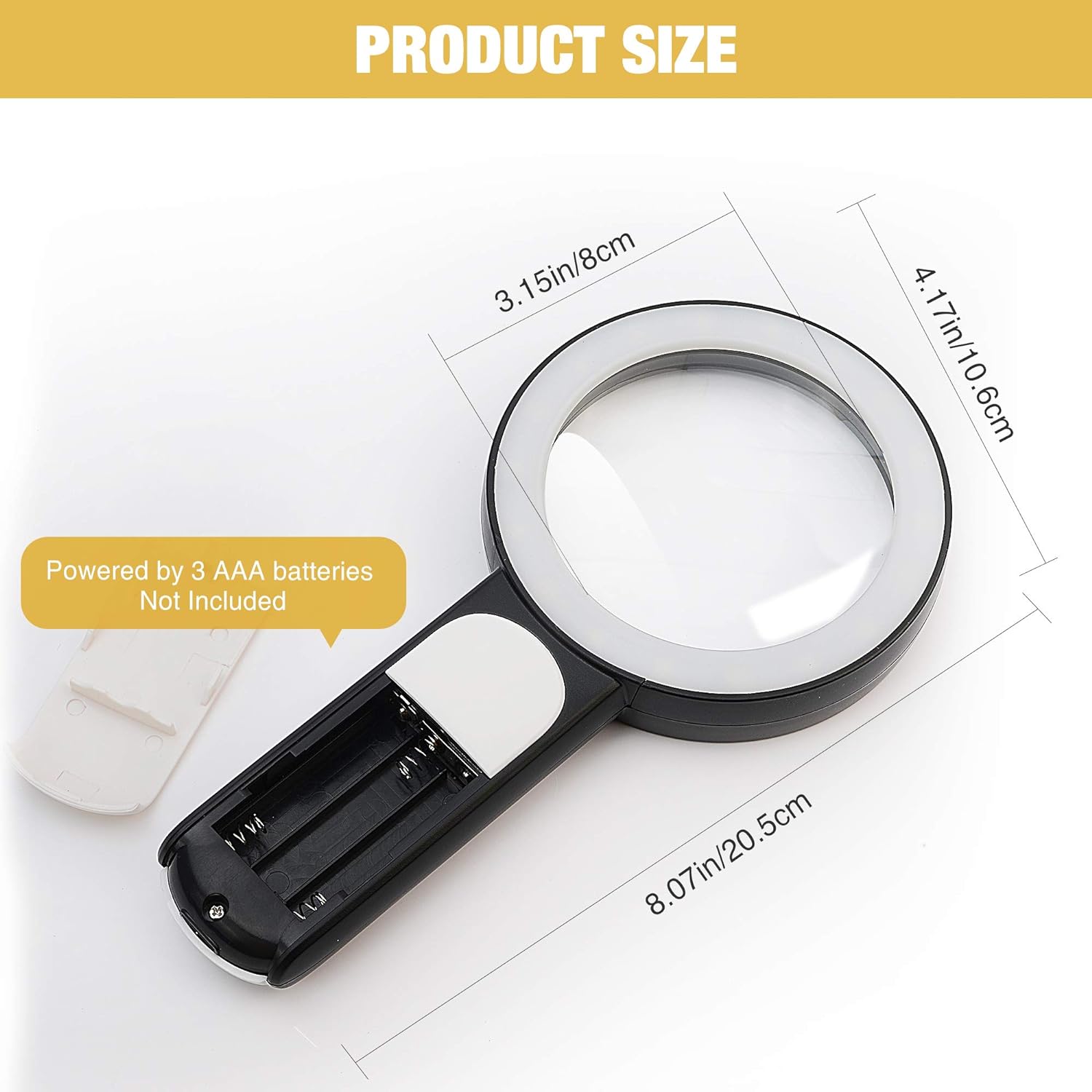
Check price on AmazonA handheld magnifier — the classic dome, bar, or pen-style lens you hold over text or an object — is the lowest-friction entry point into optical magnification. According to the American Foundation for the Blind’s optical magnifiers product category overview (afb.org), handheld optical magnifiers remain among the most commonly recommended first devices for mild-to-moderate low vision, precisely because they require no setup, no charging, and no learning curve.
The practical trade-off is immediate: your hand is occupied. For users with tremor, arthritis, hemiplegia, or significant hand fatigue, holding a lens steady long enough to read a paragraph is exhausting or impossible. That’s not a flaw in the product — it’s a form factor mismatch.
Where handheld wins: Spot tasks. Price tags, labels, menus, phone screens in bright light, anything that takes under 60 seconds. Portability beats everything else for this use case.
Where it breaks down: Sustained reading, bilateral tasks (knitting, woodworking, cooking), and any activity where tremor or grip weakness is in play.
Illumination matters more than most buyers expect. Owners consistently identify LED ring illumination — a circular array of LEDs surrounding the lens on all sides — as the single biggest functional upgrade over basic, unlit magnifiers. Reviewers with vision in only one eye specifically note that side-lit models create persistent shadows on their dominant side, while a 360-degree ring design eliminates that shadow entirely. That’s not a minor comfort preference; uneven illumination directly degrades contrast sensitivity for users with reduced peripheral vision or monocular conditions. The Royal National Institute of Blind People’s “Choosing a Magnifier” guide emphasizes that even distribution of task lighting is a primary accessibility feature for users with uneven visual fields, not a cosmetic upgrade. If you’re recommending or purchasing a handheld magnifier for anyone with asymmetric vision loss, LED ring illumination should be treated as a clinical specification.
Best suited to: Occasional spot readers, travelers, users with mild vision loss who need a pocket solution. Budget entry-level handheld magnifiers with LED ring illumination typically retail in the $15–$40 range and represent the most accessible starting point for new low vision aid users.
Stand and Page Magnifiers: Hands-Free Reading, With a Learning Curve
Magnifying
$19.99
In stock on Amazon
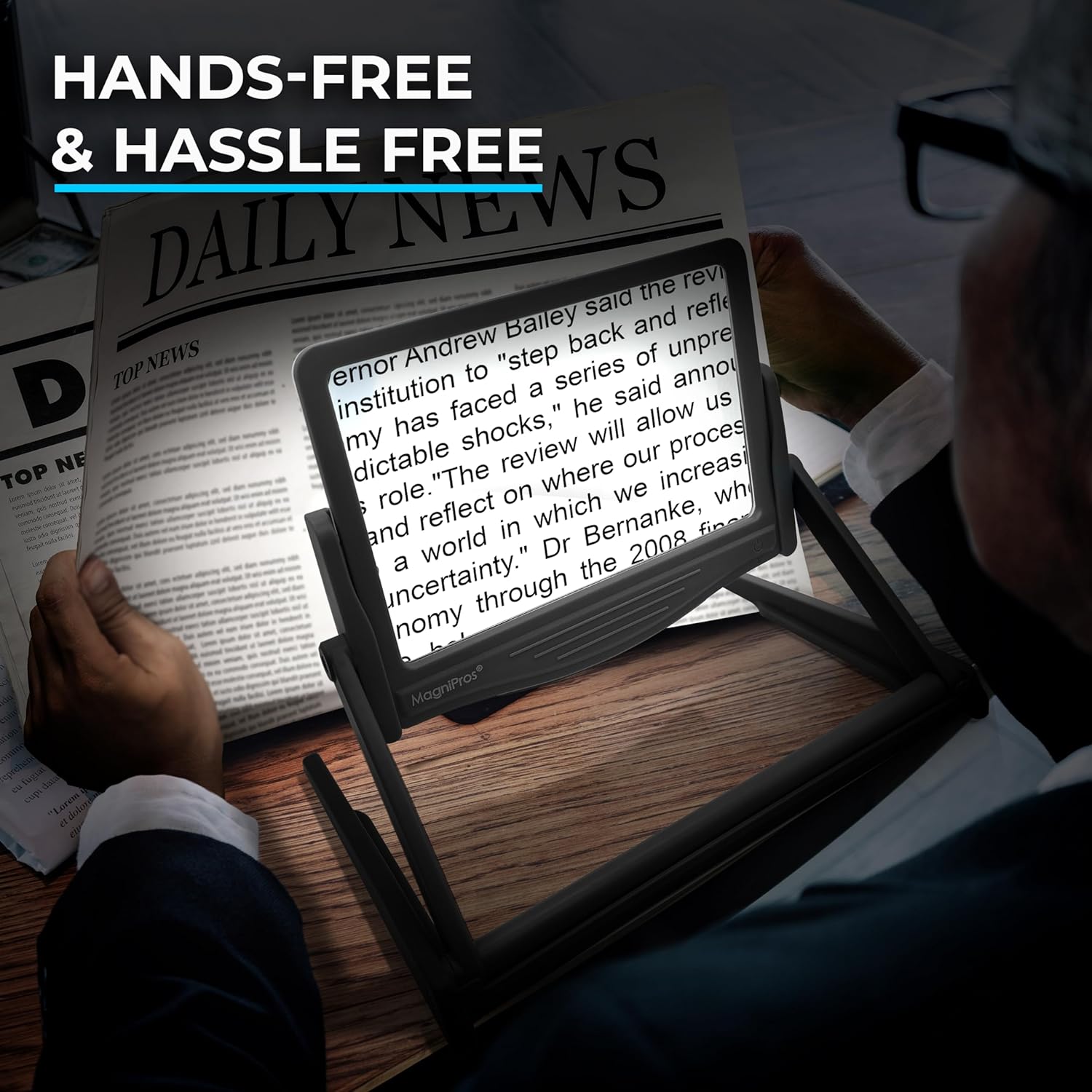
Check price on AmazonStand magnifiers — which rest directly on the page or surface — solve the grip and tremor problem by removing the holding requirement entirely. Page magnifiers, a subset of this category, are large flat lenses (often Fresnel-style, discussed below) meant to sit over an entire page of text.
The American Occupational Therapy Association’s low vision practice resources (aota.org) identify stand magnifiers as a preferred recommendation when a client presents with upper extremity fatigue or fine motor instability, because the lens-to-surface distance is fixed, which also stabilizes focus for users with reduced accommodation — the eye’s ability to adjust between distances.
A persistent buyer confusion point worth naming directly: Multiple owners of flat page magnifiers report genuine surprise that these devices must be lifted off the page to achieve magnification — that when the lens lies flat against the surface, it produces little or no magnification effect. This isn’t a defect; it’s an inherent property of how flat lens optics work. The Royal National Institute of Blind People’s “Choosing a Magnifier” guide explains that focal distance — the gap between lens and object — is what generates the magnifying effect. For many page magnifiers, that sweet spot is 2–4 inches above the surface. Owners who discover this mid-unboxing often interpret it as a broken product; a brief pre-purchase demonstration or video tutorial prevents unnecessary returns and the loss of confidence that often follows.
The Fresnel lens distortion question is real and unresolved for some users. Fresnel lenses — thin plastic lenses with concentric ridges that approximate a curved surface — are common in page magnifiers because they allow a large, lightweight, inexpensive lens area. The trade-off is optical quality: the ridges introduce micro-distortions, particularly at the edges of the viewing field. ABLEDATA’s optical magnifiers product category overview (abledata.acl.gov) describes this as a known and documented characteristic of Fresnel optics versus ground-glass lenses: glass is optically superior for sustained reading; Fresnel wins on weight, size, and price. Reviewers of flat Fresnel page magnifiers — across multiple mid-range products in this category — consistently flag edge distortion as a return-prompting issue, with at least some buyers rating the distortion as unusable for text reading.
By the Numbers: Page Magnifier Lens Trade-Offs
| Factor | Glass lens | Fresnel plastic |
|---|---|---|
| Optical clarity | Higher | Lower (edge distortion) — Magnifying — $19.99 |
| Weight | Heavier | Lighter — JMH — $9.99 |
| Price point | Higher | Lower — JMH — $9.99 |
| Durability | Break risk | Scratch risk — Magnifying — $19.99 |
| Best for | Sustained reading | Casual / brief use — JMH — $9.99 |
Best suited to: Users with tremor or grip weakness, sustained home reading tasks, users who can learn the focal distance mechanic. Mid-range stand and page magnifiers with glass lenses typically retail in the $30–$80 range; Fresnel plastic page magnifiers often cost $15–$35.
Head-Worn Magnifiers: The Bilateral Task Solution
MAGNIPROS
$24.95
In stock on Amazon
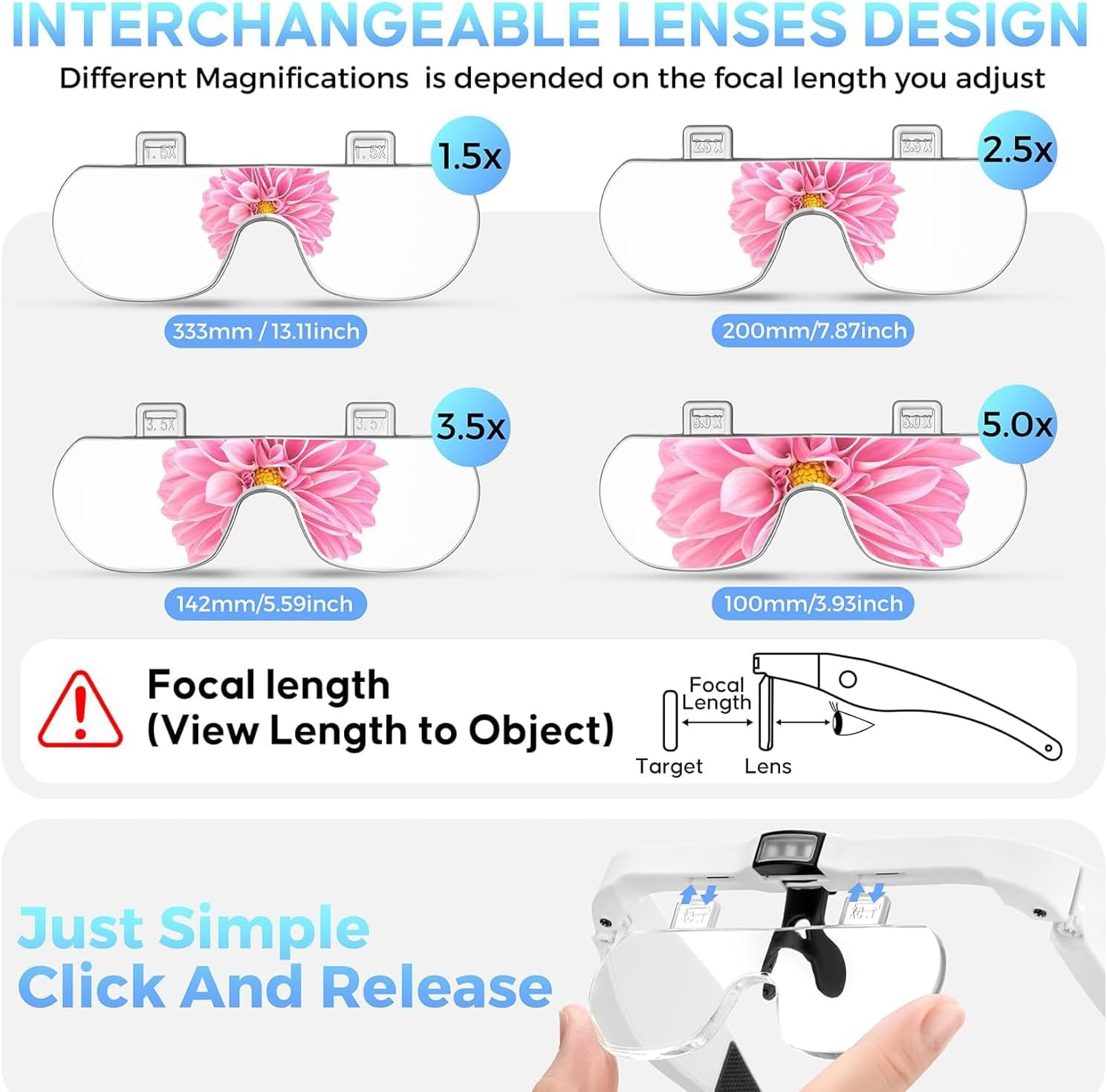
Check price on AmazonHead-worn magnifier headsets — worn like glasses or a visor — free both hands completely. This is the form factor purpose-built for detail work: electronics repair, fine needlework, jewelry making, surgical suture practice, and any craft where the hands must manipulate small objects while the eyes track them simultaneously.
The functional mechanism is straightforward: a loupe or lens array is mounted in front of the eye at a fixed working distance, leaving the visual field magnified without hand involvement. Craft hobbyists and detail-oriented professional users make up the majority of satisfied head-worn magnifier reviewers, with multiple owners noting they can work for extended sessions — 60 to 90 minutes — without the neck fatigue they experienced with heavier headband-style units. Lightweight construction is a meaningful differentiator for any session exceeding 30 minutes; practitioners advising clients should treat gram weight as a clinical specification, not a preference.
A common clinical question from OTs and family caregivers: Can these units be worn over prescription eyeglasses? The answer, based on aggregated owner reports and manufacturer documentation across this product category, is generally yes for headband-style units with adjustable nose bridges — though comfort and optical alignment vary significantly by frame type. Users with thicker prescription frames report mixed results; some note that the magnification zone doesn’t align correctly when the headset sits proud of the prescription lens. This is worth building into a trial or return window if purchasing for a client who wears strong prescriptions.
The American Foundation for the Blind’s assistive technology product resources (afb.org) note that proper fitting and working distance calibration are essential for head-worn optical aids — a rushed fitting undermines both comfort and clinical effectiveness.
Best suited to: Craft hobbyists, electronics repair technicians, clinical or laboratory professionals, any user requiring sustained bilateral hand use under magnification. Premium head-worn headset magnifiers with multiple interchangeable lens strengths and LED task lighting typically retail in the $40–$120 range, with professional-grade units reaching higher.
Floor Lamp Magnifiers: The Ambient-Task Category
A fourth form factor worth naming separately: the floor lamp with an integrated magnifying lens, positioned over a chair or workstation on an articulating arm. This is the form factor most often gifted to seniors who knit, embroider, or do fine handwork under low ambient light — and for that use case, it solves multiple problems simultaneously: stable hands-free magnification, task lighting, and postural neutrality (no bending over a tabletop).
Floor lamp magnifiers in this category draw strong reviews from users performing seated craft work, with multiple buyers reporting purchase as a gift for elderly family members. However, at least one professional user across reviewed products in this category flagged a meaningful limitation: the stand does not extend to adequate height for all task setups. If your client works at a standing desk or elevated worktable, the maximum arm reach of a floor lamp magnifier may not reach the working surface. Height range is a specification worth confirming against the client’s actual workstation before recommending.
Stability is a related concern for fine craft work. Owners of floor lamp magnifiers generally describe the base as stable on flat surfaces, with no wobble during normal use — but none of the reviewed units are rated for industrial or high-vibration environments.
Magnifying
$19.99
In stock on Amazon
Check price on AmazonBest suited to: Seated crafters, knitters, embroiderers, seniors with ambient lighting needs. Mid-range floor lamp magnifiers with daylight-spectrum LED illumination and articulating arms typically retail in the $50–$120 range.
The Decision Framework: If X, Then Y
This is where practitioners with a current recommendation pending can compress the above into a working decision rule:
If the primary task is spot reading (labels, menus, fine print, under 60 seconds): Handheld magnifier with LED ring illumination. Prioritize ring-style LED over side-mounted. Glass lens preferred over Fresnel for clarity; Fresnel acceptable for weight-sensitive users.
If the user has tremor, grip weakness, or upper extremity fatigue: Stand or page magnifier. Prepare the user for the lift-to-magnify mechanic before purchase. Recommend glass lens over Fresnel for sustained reading; Fresnel acceptable for occasional use or large-field tasks.
If sustained detail work requires both hands free (craft, repair, clinical tasks): Head-worn headset. Confirm prescription glasses compatibility before purchasing. Lightweight construction is a meaningful differentiator for sessions over 30 minutes.
If the user is a seated crafter or knitter with ambient lighting needs: Floor lamp magnifier. Confirm maximum arm height against actual task height before recommending. Stability is adequate for normal craft use based on owner reports.
If visual condition is monocular or involves asymmetric vision loss: Prioritize 360-degree LED ring illumination in any form factor. Per the Royal National Institute of Blind People’s “Choosing a Magnifier” guide, even distribution of task lighting is a primary accessibility feature for users with uneven visual fields — shadow elimination is clinically meaningful, not cosmetic, for this population.
Frequently Asked Questions
Does lifting the page magnifier off the surface really increase magnification, and how far should I hold it?
Yes — this surprises a lot of first-time buyers. The lens needs a gap between itself and the page to create a magnified image. Most flat page magnifiers have an optimal focal distance of roughly 2–4 inches above the surface, though this varies by lens curvature and magnification rating. Holding it too close or too far reduces clarity. Expect a brief adjustment period to find your focal sweet spot.
Is the Fresnel plastic lens as clear as glass, and does it distort text?
It isn’t, and for some users the distortion is significant enough to make it unusable for sustained text reading. Fresnel lenses work through concentric ridges rather than a continuously curved surface, and those ridges create micro-distortions — especially at the edges. ABLEDATA’s optical magnifiers product category overview describes this as a documented trade-off of the Fresnel design. If text clarity is the primary use case, a glass lens stand magnifier is the safer specification.
Can the head-worn headset magnifier be worn over prescription glasses?
Generally yes, based on manufacturer design intent and owner reports — but alignment and comfort vary depending on prescription frame thickness and shape. Users with standard-thickness frames report satisfactory results; users with thick or wraparound frames occasionally report misalignment of the magnification zone. Build a return window into any institutional purchase.
How long do the rechargeable batteries last on illuminated page magnifiers and head-worn units?
Battery life varies by unit and has not been independently verified here, but owner-reported figures for LED-illuminated page magnifiers cluster around 4–8 hours per charge at moderate brightness settings. Head-worn units with LED illumination typically fall in a similar range. Neither category is rated for all-day continuous professional use without recharging.
Is the floor lamp magnifier stable enough for fine craft work, or does it wobble?
Owner accounts consistently describe the floor lamp base as stable on flat floors for normal craft activity — knitting, embroidery, fine handwork. No systematic wobble complaints appear in reviewed feedback for this category. The arm’s maximum height range, however, may be a limiting factor for elevated task surfaces; confirm the specification matches your client’s actual workstation before recommending.